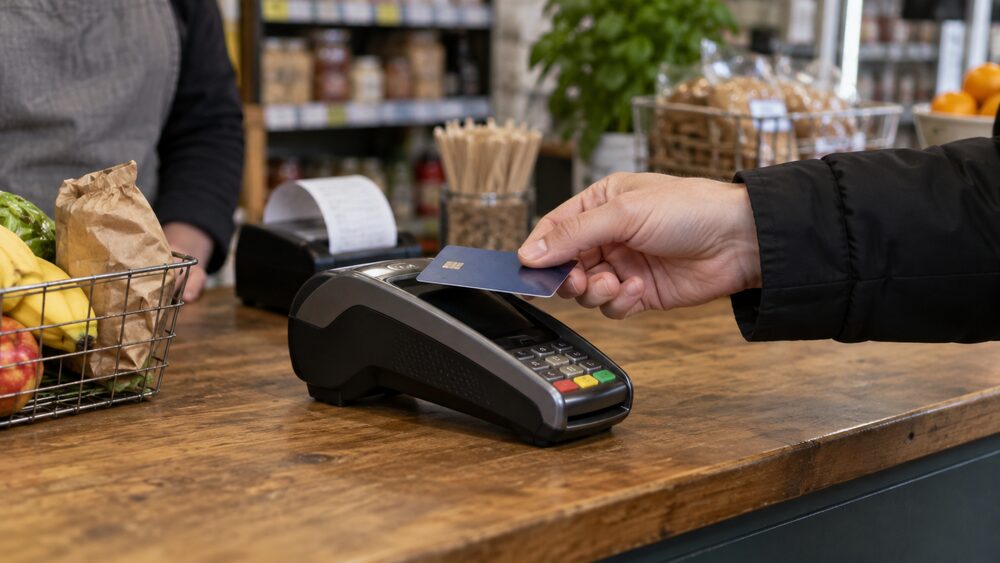
Every time you pay by card, money moves between more parties than just you and the shop. One of those movements is the interchange fee: a payment from the shop's bank to your bank. The Payment Systems Regulator (PSR) describes it plainly: "Interchange fees are fees paid by the bank of a merchant (such as a supermarket) to the bank of a card user (such as somebody buying groceries) when a card payment is made"1. You never see this fee on your statement, and shops are banned from adding a surcharge just because you paid by card2. But the fee is real money, and it shapes both the prices shops charge and the rewards and annual fees on your credit cards.
In the UK, interchange fees on domestic card payments are capped at 0.2% of the transaction value for consumer debit cards and 0.3% for consumer credit cards3. Those caps do not follow a UK card abroad in the same way: for online payments between the UK and the European Economic Area (EEA), Mastercard and Visa raised fees from 0.2% and 0.3% to 1.15% and 1.5% respectively, and the PSR estimates this costs UK businesses £150 to £200 million extra each year4. A separate review found the schemes' own scheme and processing fees rose by at least 25% since 2017, costing businesses at least £170 million extra per year5.
What interchange and scheme fees are, and who pays them
A card payment involves a chain of parties, and each link can carry a fee. The interchange fee is the payment the shop's bank (or more precisely its acquirer, the firm that processes card payments for the shop) makes to the bank that issued your card. The level of the interchange fee is set not by either bank but by the card scheme, the network such as Mastercard or Visa that sits between them6. Interchange is one part of the total cost to the merchant of processing a card payment, which is known as a merchant service charge1.
Scheme fees are different. The PSR defines them as "those charged by scheme operators to participate in the scheme"7. These are fees the acquirer pays to Mastercard or Visa for using their networks, and they are not capped by the interchange rules. The PSR's review of these fees found that Mastercard and Visa do not face effective competition, with fees rising and a lack of clarity about how much businesses will have to pay to accept card payments7.
Interchange also appears in a different form at cash machines. Free-to-use ATMs generate fees for their providers through per-transaction ATM interchange fees paid by the card issuing banks and building societies8, and these fees are set by the LINK Board9. On the LINK network this costs around 25 pence per withdrawal10. A 2012 Treasury Committee report recorded the rates then in force: card issuers could be charged 26 pence for cash withdrawals, up to 35 pence at off-premises or "remote" cash machines, and 16 pence for balance enquiries11. The PSR has since consulted on the structure of LINK interchange fees, focusing on how they are structured rather than their level12.
Interchange fees before the cap: around 0.8% of a card payment
Before the caps arrived, interchange fees on consumer credit cards were far higher than today. The FCA's credit card market study found that the average interchange fee on such cards had been around 0.8% of transaction value (80 basis points)13, and its interim report put the same figure at around 0.8% as at November 201414. The range was wide: fees for consumer credit card transactions ran from 0.65% to 1.85% of transaction value, depending on the card payment system (Mastercard or Visa), the card type (for example standard or premium) and the transaction type14.
That 0.8% average mattered because it was revenue for the card issuer, and it funded much of what cardholders saw in return: cashback, points, interest-free periods and waived annual fees. The FCA noted that firms' estimates of the reduction in income from the cap averaged 5% to 10% of overall revenue14. In other words, the cap was expected to take a meaningful slice of card issuers' income, and the industry's response was predictable.
The cap itself came from the European Commission, whose initial proposal was for a cap of 0.2% of the transaction value for consumer debit card transactions and 0.3% for consumer credit card transactions15. The FCA anticipated at the time that the level of interchange fees and the regulation of card payment systems would fall within the purview of the newly established Payment Systems Regulator15, which is what happened.
The UK cap: 0.2% on debit cards and 0.3% on credit cards
The Interchange Fee Regulation (IFR) is EU legislation that took effect on 8 June 2015 and brought major changes to the way card schemes operate, most notably by introducing a cap on certain interchange fees3. The default cap set in the IFR is 0.2% of the value of the transaction for debit cards and 0.3% for credit cards16. For consumer credit cards specifically, the cap of 30 basis points (0.3%) of transaction value applied from 9 December 201514. The regulation's Phase 1 provisions were in force by 9 December 2015, and its Phase 2 provisions came into force on 9 June 20161.
The UK government consulted on how to implement the regulation, running its consultation from 10am on 27 July 2015 to 11:59pm on 28 August 201517. HM Treasury's decisions included taking no further action on the caps for domestic credit card transactions while applying a weighted average approach to domestic debit card transactions, and granting three-party card systems that operate with licensee issuers or acquirers a time-limited exemption from the domestic caps as long as the value of their annual transactions was less than 3% of all card-based transactions in the UK16. That exemption is why some American Express cards sit outside the caps: the UK IFR caps interchange fees on consumer debit and credit card transactions, except some American Express cards3.
Following EU withdrawal, the onshored IFR is now retained UK law, which applies in the UK as amended by the Interchange Fee (Amendment) (EU Exit) Regulations 201918. The Treasury designated the PSR as the lead competent authority for the IFR in the UK, and the PSR's powers to monitor and enforce it are set out in the Payment Card Interchange Fee Regulations 20153. The PSR has published final guidance on how it will monitor and enforce the regulation, covering who the IFR applies to, the caps and exemptions, the separation of card scheme and processing entities, co-badging and choice of payment brand, the honouring of all cards, compliance monitoring, complaints investigation, and its powers and penalties1.
How capped fees changed credit card rewards and annual fees
The cap cut a large hole in card issuers' income. The FCA's final findings described the effect: credit card firms' revenue from interchange fell from around 80 basis points to 30 basis points, "a gross reduction of around 60% in interchange revenue across the industry"13. The interim report had already set out what firms said they would do about it: "Firms say they will respond by offering more products with a small or increased annual fee or diluting rewards schemes"14.
That is what shoppers have lived with since. Annual fees on reward cards were already common before the cap: the FCA found most fees were around the £25 per year level, although they went up to £150 for some airline co-brand cards14. Today, reward cards still carry fees of that order; for example, NatWest's reward credit card lists a £24 annual fee19. Research on other markets points the same way: a review of credit card literature found that the EU regulation caps the fee at 0.3% of credit card transaction values, and that paying a fee in one month reduces fee payment in the current month by 40% and monthly fee payment by 75% during the first four years of a US cardholder's account life, evidence that consumers adapt slowly to fees20.
The practical point for a shopper is simple: the interchange cap lowered the costs shops pay to accept cards, but it also removed much of the funding for generous cashback and points schemes. Cards that still offer rewards are more likely to charge an annual fee, and the rewards themselves are less rich than in the era of 0.8% average interchange.
Mastercard and Visa handle 99% of UK card payments
Two networks sit behind almost every card payment in the UK. The PSR notes that Mastercard and Visa account for 99% of debit and credit card payments in the UK4, a figure repeated in its consultations21. In 2018 the two schemes together accounted for 98% of all card payments at UK outlets, both by number of transactions and by value6. The bulk of UK payments still go through the existing card systems, usually Visa or Mastercard, even as account-to-account payments grow22.
This concentration is why the regulator's attention has fallen on the two schemes. Contactless use has grown alongside it: in August 2023, contactless payments accounted for 64% of all credit card and 76% of all debit card transactions23. When two firms set the fees for 99% of a market, and those fees feed into the prices of nearly every purchase, the competitive constraints on them matter to everyone, not just to retailers.
Paying in the EU with a UK card: fees the cap does not cover
Brexit changed which payments the cap covers. The EU's regulation of interchange fees on card transactions was replaced in the UK by a regulation that applies only to UK-issued cards used in the UK6. Consumer cross-border card payments between the UK and the EU (or any other third country), where either the acquirer or the issuer is based outside the UK's jurisdiction, are no longer subject to the interchange fee caps established under either the UK IFR or the EU IFR18. The PSR states this plainly: the UK IFR caps interchange fees on consumer debit and credit card transactions where the point of sale (the merchant), the acquirer and the card issuer are all within the UK3.
The consequences run in both directions. When the holder of a UK-issued card buys goods or services from a merchant in the EEA, the cap on the interchange fee is now higher than before Brexit6. And when the holder of a non-UK-issued card buys from a UK merchant, the interchange fee paid by the merchant through its acquirer is no longer capped6.
Shortly after EU withdrawal, Mastercard and Visa increased interchange fees for card-not-present transactions, meaning online payments, using consumer debit and credit cards between the UK and the EEA: Mastercard from 0.2% to 1.15% and Visa from 0.3% to 1.5%8. The PSR's working paper records the same increase, from 0.2% and 0.3% to 1.15% and 1.5%25. The PSR has described these fees as having increased five-fold since the UK left the EU21. Both schemes have also told the regulator they plan to increase some cross-border interchange fees further6.
For a shopper using a UK card abroad, separate charges can apply on top: current accounts often charge a foreign exchange fee of around 3% of the transaction amount when you use your debit card abroad26, and Which? warns that spending just £5 with a card that charges fees could set you back £1.15, an additional 23%27. Those are charges on your side of the transaction; the interchange increase is on the merchant's side.
Scheme and processing fees rose by at least 25%
Interchange is not the only fee that has climbed. The PSR's final report on card scheme and processing fees, published in March 2025, found that Mastercard and Visa increased their core scheme and processing fees to acquirers by at least 25% since 2017, costing businesses at least £170 million extra per year5. The remedies consultation that followed, CP25/1, repeats both figures28.
The remedies the PSR has proposed are not price caps but transparency measures: better information for merchants and acquirers by requiring schemes to provide more information on fees so merchants can compare; regulatory financial reporting; better pricing governance; and publication by schemes of more information to improve accountability and transparency28. The consultation closed on 28 May 202528.
The PSR's earlier call for evidence on competitive constraints in card payment systems had identified four themes: the intensity of competition and innovation in the payments ecosystem; differences in the competitive dynamics on the issuing and acquiring sides of the market; the impact of transparency on competitive pressure at all levels of the value chain; and the must-take status of Mastercard- and Visa-branded cards in many retail environments29. That last point is the heart of the problem: shops cannot realistically refuse the cards nearly every customer carries, so they cannot walk away from fee rises.
How fees paid by shops reach the prices you pay
The interchange fee is one part of the merchant service charge, the total cost a shop pays to accept a card payment1. The Financial Services Consumer Panel noted that the average merchant service charge for card payments was 0.6% of each transaction in 201830. The IFR caps certain interchange fees but does not cap the merchant service charge itself, nor does it set requirements on how merchants should respond to changes in the charges they face2.
How those costs reach shoppers is indirect but real. Since 13 January 2018, shops are not allowed to charge their customers extra if they pay using certain payment methods, including debit and credit cards2. So a shop cannot pass the cost on only to card users at the till. What it can do is build its total costs into the prices it sets for everyone. When the PSR found that cross-border fee increases cost UK businesses £150 to £200 million a year, its concern was precisely that these costs feed through to the prices UK consumers pay4.
Some public bodies do charge for card payments where the rules allow. HMRC's fee for card payments is set in legislation as equal to the sum of the merchant acquirer fee, the interchange fee and the scheme fee for the payment31. And the reach of card fees may extend further as wallets grow: the Financial Services Consumer Panel concluded from publicly available material that digital wallet fees are either extracted from the interchange or waived in lieu of data usage32.
What the regulator has found and what it has decided
The PSR has run two connected market reviews: one into card scheme and processing fees, and one into UK-EEA consumer cross-border interchange fees21. The cross-border review was prompted by Mastercard and Visa significantly raising some of these fees in 2021 and 202233. Its interim report, published in December 2023, set out provisional findings and proposed remedies, including an initial time-limited cap of 0.2% for UK-EEA consumer debit transactions and 0.3% for consumer credit transactions made online at UK businesses33.
The final report, published in December 2024, confirmed the PSR's concerns: Mastercard and Visa have likely raised these fees to an unduly high level, at the expense of UK businesses, and a lack of competition in the market leads to costly price increases with an unclear rationale24. The PSR estimated that in 2022 alone, UK businesses paid an extra £150 to £200 million due to the fee increases24, and its Stage 1 remedy consultation described merchants as paying £150 to £200 million a year more in fees than they would if the market worked properly34. The proposed remedy is a two-stage price cap: an initial interim cap for a limited time while further analysis establishes an appropriate methodology and level for a longer-lasting cap34.
The PSR has also examined the acquiring side of the market, where shops buy their card-processing services. Its market review into the supply of card-acquiring services, with draft terms of reference published in July 2018 and final terms in January 2019, looked at the fees merchants pay and the quality of service they receive, and proposed remedies including requiring all card-acquiring contracts to have an end date to prompt merchants to shop around, limiting the length of POS terminal contracts and ending auto-renewal, and making it easier for merchants to research and compare prices35.
For consumers, the PSR states it is examining card fees to ensure businesses and consumers are getting a good deal on card payments36. Anyone can send views to its market review team by email, or write to the Payment Systems Regulator at 12 Endeavour Square, London, E20 1JN8. The PSR's work sits alongside the FCA's oversight of the credit card market itself, and you can read more about who regulates what, the Payment Systems Regulator and financial services rules after Brexit on this site. If you have a complaint about a card or a bank rather than about the fees system, the Financial Ombudsman or court route explains where to take it.
Sources36 cited
- Application of the IFR: final guidance Payment Systems Regulator
- The IFR and consumers Payment Systems Regulator
- The IFR Payment Systems Regulator
- Market review into cross-border interchange fees Payment Systems Regulator
- Market review of card scheme and processing fees: final report Payment Systems Regulator
- Why are interchange fees going up on UK-EU card transactions? Payment Systems Regulator
- Market review into card scheme and processing fees Payment Systems Regulator
- Final terms of reference for cross-border interchange fees market review Payment Systems Regulator
- Draft specific direction 8: protected ATMs Payment Systems Regulator
- The UK's ATM network Payment Systems Regulator
- Card interchange fees: Treasury Committee report House of Commons Treasury Committee, 2012-08-31
- Call for views: review of the structure of LINK interchange fees Payment Systems Regulator
- Credit card market study: final findings report Financial Conduct Authority, 2016-07
- Credit card market study: interim report Financial Conduct Authority, 2015-11
- Credit card market study MS14/6.1 Financial Conduct Authority, 2014-11
- Credit card market study interim report, Annex 2 Financial Conduct Authority, 2015-10-08
- Interchange Fee Regulation consultation HM Government, 2015-07-27
- Card payments Payment Systems Regulator
- NatWest credit cards NatWest
- Review of credit card literature Financial Conduct Authority, 2015-10-19
- Market review of UK-EEA consumer cross-border interchange fees Payment Systems Regulator
- Account-to-account payments Payment Systems Regulator
- CP23/29 consultation paper Financial Conduct Authority, 2023
- Market review of UK-EEA consumer cross-border interchange fees: final report Payment Systems Regulator, 2024-12
- Impact of the UK-EEA cross-border interchange fee increases: working paper Payment Systems Regulator, 2023-01-11
- How to open, switch or close your bank account MoneyHelper
- Spending abroad: the 4 dos and 5 don'ts Which?, 2024-07-26
- CP25/1: card scheme and processing fees remedies consultation Payment Systems Regulator
- Competitive constraints in card payment systems: call for evidence Payment Systems Regulator
- FSCP response to HMT Payment Services Regulations review Financial Services Consumer Panel
- The Payment Card Fees Regulations 2020 legislation.gov.uk, 2020-06-29
- FSCP response to PSR call for input on big tech and digital wallets Financial Services Consumer Panel, 2024-09-13
- Market review of UK-EEA consumer cross-border interchange fees: interim report Payment Systems Regulator, 2023-12-19
- CP24/14: Stage 1 remedy consultation Payment Systems Regulator
- Market review into the supply of card-acquiring services: interim report Payment Systems Regulator
- How we help you Payment Systems Regulator



 Financial Ombudsman ServiceFree, independent help when a complaint about a firm is not put right
 FSCSProtects your money if a bank, insurer or investment firm fails
 FCA Warning ListCheck whether a firm is authorised before you deal with it
 MoneyHelperFree, impartial money and pensions guidance, set up by government
 Citizens AdviceFree advice on money, consumer and legal problems in England and Wales