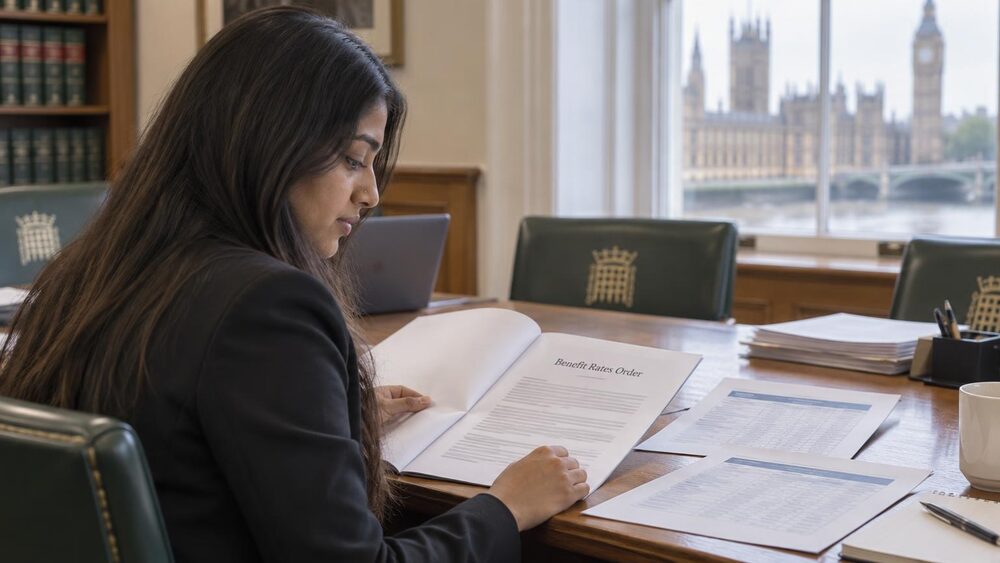
The Social Security Benefits Up-rating Order 2026 sets the rates of State Pensions and benefits for the 2026/27 tax year, replacing SI 2025/295 which covered 2025/261. The Secretary of State announced his up-rating decisions to Parliament in a Written Ministerial Statement on 26 November 20251. The Order provides for the annual up-rating of social security benefits specified in sections 150, 150A and 151A of the 1992 Act1.
Certain Universal Credit and income-related Employment and Support Allowance rates are not covered by the Order. The Universal Credit Act 2025 removed them from the Secretary of State's up-rating review and provided a separate framework for altering them. "They are therefore not covered by the Order and will be subject to separate provision which will come into force on the same date as this Order"1.
The basic State Pension rises by 4.8% from April 2026, because earnings growth over the relevant period (4.8%) was higher than both price growth (3.8%) and 2.5%1. The full basic pension in Category A and Category B rises from £176.45 to £184.90 a week, and the lower rate of Category B basic pension rises from £105.70 to £110.75 a week1. The full rate of the new State Pension rises by 4.8%, from £230.25 to £241.30 a week1.
Other rates rise by 4.8% from April 2026, including the Pension Credit standard minimum guarantee and the widow's and widower's pension in Industrial Death Benefit1. Rates rising by 3.8% from April 2026 include Additional State Pension, Attendance Allowance, Carer's Allowance, Disability Living Allowance, Incapacity Benefit, Industrial Injuries Disablement Benefit, Personal Independence Payment, Severe Disablement Allowance, Widowed Mother's Allowance and Widowed Parent's Allowance1. The same 3.8% applies to personal allowances in Housing Benefit, Income Support and Jobseeker's Allowance; additional amounts in Pension Credit payable on grounds of disability and caring responsibilities; carer and disability premiums in Income Support, Jobseeker's Allowance and Housing Benefit; the child amounts, carer amounts and transitional severe disability premiums in Universal Credit; contributory Employment and Support Allowance; and pensioner and carer premiums in income-related Employment and Support Allowance1. Statutory Sick Pay and the statutory family payments also rise by 3.8%1. Bereavement Support Payment rates remain the same as in 2025/261.
The Secretary of State has also decided to increase the savings credit threshold in Pension Credit to deliver an increase in the savings credit maximum in line with the increase in CPI1. The majority of new rates are rounded to the nearest 5 pence1.
| Measure | Change from April 2026 |
|---|---|
| Basic State Pension (Category A and B full rate) | £176.45 to £184.90 a week |
| Category B basic pension, lower rate | £105.70 to £110.75 a week |
| New State Pension, full rate | £230.25 to £241.30 a week |
| Pension Credit standard minimum guarantee | Up 4.8% |
| Attendance Allowance, Carer's Allowance, DLA, PIP | Up 3.8% |
| Universal Credit child and carer amounts | Up 3.8% |
| Bereavement Support Payment | Unchanged from 2025/26 |
Taken together, the total cost of up-rating changes in 2026/27 will be £11 billion, of which £9 billion is given effect through the Order, and overall Exchequer expenditure will increase by £9 billion in 2026/271.
The extent of the instrument is Great Britain, save for articles 1, 3, 7, 14 and 15 insofar as they relate to the devolved benefits1. Executive functions in relation to Carer's Allowance for residents in Scotland transferred to the Scottish Ministers with effect from 3 September 2018, and functions in relation to Attendance Allowance, Disability Living Allowance, Industrial Injuries Benefits, Personal Independence Payment and Severe Disablement Allowance transferred with effect from 1 April 20201. The Scottish Ministers will make provision for the up-rating of Industrial Injuries Benefits and Severe Disablement Allowance in Scotland1. The Department for Communities will be responsible for bringing forward corresponding provision for Northern Ireland1.
Why it matters for households
Most working-age and pensioner benefits paid by the Department for Work and Pensions in Great Britain are affected from April 2026, with the amounts set out above. The 4.8% rise applies to the basic and new State Pensions and to the Pension Credit standard minimum guarantee, while the 3.8% rise applies to disability and carer benefits and to elements of Universal Credit such as the child and carer amounts. People receiving contributory Employment and Support Allowance see a 3.8% rise, but the income-related ESA rates removed from the review by the Universal Credit Act 2025 are dealt with separately. Bereavement Support Payment is unchanged in cash terms, so its value falls relative to prices. The £11 billion total cost figure covers the up-rating changes as a whole, of which £9 billion flows through this Order.
What happens next
The separate provision covering the Universal Credit and income-related ESA rates removed from the review comes into force on the same date as the Order1. The Scottish Ministers will bring forward provision for Industrial Injuries Benefits and Severe Disablement Allowance in Scotland, and the Department for Communities will bring forward corresponding provision for Northern Ireland1.
Sources1 cited
- The Social Security Benefits Up-rating Order 2026 legislation.gov.uk
 Turn2usFree benefits calculator and grants search from a charity
 Citizens AdviceFree advice on money, consumer and legal problems in England and Wales
 GOV.UKOfficial information on tax, benefits and government services
 MoneyHelperFree, impartial money and pensions guidance, set up by government