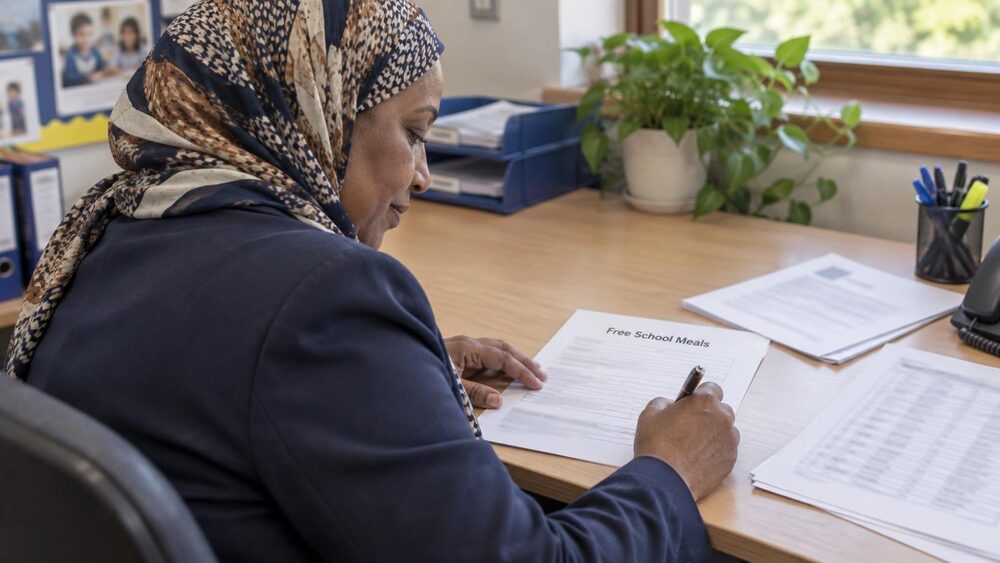
The UK government announced in June 2025 that, from September 2026, the eligibility criteria for Free School Meals (FSM) in England will be expanded to all children in families receiving Universal Credit1. The Department for Work and Pensions described the change as "a key milestone in the Government's agenda to tackle Child Poverty and ensure all children have the Best Start in Life"1. Full details are to be set out later in a comprehensive Child Poverty Strategy1.
Under the current rules in England, a child in a household receiving Universal Credit qualifies for free school meals only if parental earnings fall below set thresholds. Contact, a charity for families with disabled children, lists those thresholds as net earnings (joint earnings for a couple) of no more than £616.67 in the monthly assessment period before the claim, £1,233.34 across two assessment periods, or £1,850 across three2. Turn2us states that from the start of the 2026/27 school year all children in a household receiving Universal Credit will be eligible, regardless of household earnings3.
Separately, children in reception, Year 1 and Year 2 in England are already entitled to free lunches, as are all primary school children in London2. Children in Year 3 or above can also qualify through the guarantee element of Pension Credit or Asylum Support3. Transitional protections that previously allowed some pupils to keep free school meals after their household stopped receiving Universal Credit have ended, and Contact states it is no longer possible to qualify in that way2.
The rules differ across the UK. The table below sets out the position as reported.
| Nation | Universal Credit position |
|---|---|
| England | All children in households receiving Universal Credit from September 20261 |
| Wales | Years 7 and 8 in households receiving Universal Credit, regardless of income; Year 9 and above subject to a £7,400 after-tax household income limit3 |
| Scotland | Primary 6 and 7 and secondary pupils where monthly earnings are £995 or less; primary 1 to 5 already universal3 |
| Northern Ireland | Household income after tax of £15,900 or less per year3 |
The Scottish Government's own analysis, published on 6 August 2026, refers to "entitlement for all children in households receiving Universal Credit coming into effect from the 2026 school year"4. Applications in England are made to the local council, which may have its own form3.
Why it matters for households
The change removes the earnings test for families in England receiving Universal Credit, so eligibility from September 2026 turns on receipt of that benefit rather than on how much a household earns1. Families currently above the thresholds would gain entitlement; those already within them see no change to their position. The Department for Work and Pensions has published analysis estimating the effect on the numbers and proportions of individuals in poverty by age group in the financial year ending 2030, alongside figures on children in Universal Credit households in England by parliamentary constituency and school year as at November 20241.
The date matters for families whose circumstances change. Contact notes that transitional protections have ended, so pupils who previously kept free school meals after leaving Universal Credit no longer do so2. Until September 2026, the existing earnings thresholds continue to determine eligibility in England2. Free school meals also feed into other support: Contact states that the "targeted group" defined by the current thresholds is eligible for extended rights to home to school transport2. Whether the 2026 expansion changes that transport entitlement has not been reported.
What happens next
The government said full details of the expansion will be set out later in its Child Poverty Strategy1. The Scottish Government report, published 6 August 2026, refers to the entitlement taking effect from the 2026 school year4. No further implementation timetable for England has been reported beyond the September 2026 start date1.
 Turn2usFree benefits calculator and grants search from a charity
 Citizens AdviceFree advice on money, consumer and legal problems in England and Wales
 GOV.UKOfficial information on tax, benefits and government services
 MoneyHelperFree, impartial money and pensions guidance, set up by government