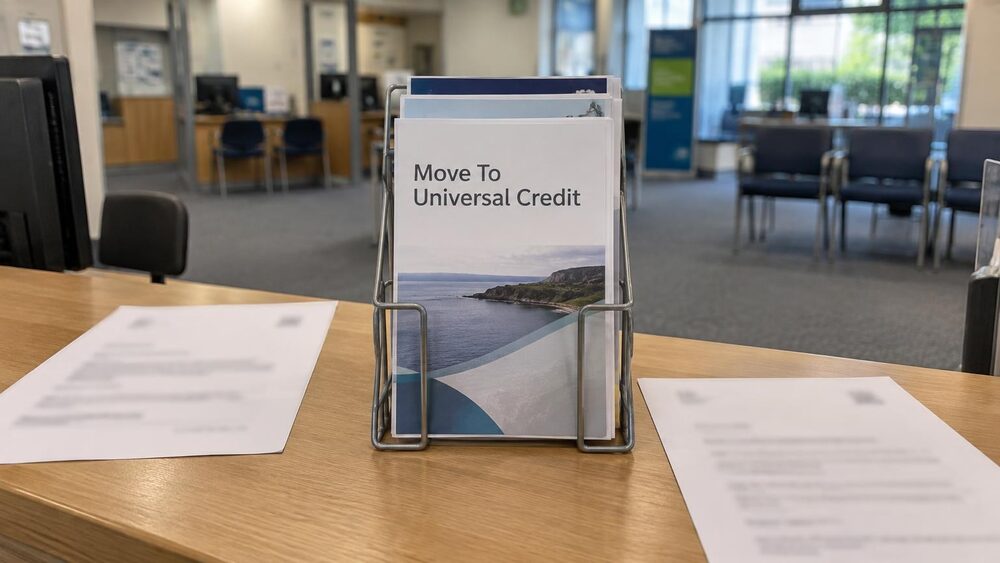
People claiming Income Support start receiving Migration Notices from May 2024, telling them their legacy benefit is ending and inviting a claim for Universal Credit1. The notices form part of managed migration, the process by which the Department for Communities writes to claimants to move them onto Universal Credit1.
The timetable set out by Law Centre NI in February 2024 runs in stages. Tax Credits with Housing Benefit began in April 2024, Income Support follows in May 2024, and Housing Benefit only and Employment and Support Allowance (Income-Related) with Child Tax Credits follow in July 2024. Income-based Jobseekers Allowance is scheduled for September 2024. Employment and Support Allowance (Income-Related) only, and with Housing Benefit, is scheduled for 2028/291.
| Claimants | Notices begin |
|---|---|
| Tax Credits with Housing Benefit | April 2024 |
| Income Support | May 2024 |
| Housing Benefit only; ESA (Income-Related) with Child Tax Credits | July 2024 |
| Jobseekers Allowance (Income-Based) | September 2024 |
| ESA (Income-Related) only; ESA (Income-Related) with Housing Benefit | 2028/29 |
The timetable above describes Northern Ireland, where Law Centre NI operates; it states that managed migration there currently covers Tax Credit only claimants, with notices for other benefits commencing on the dates listed1. The guidance states that managed migration applies to anyone who has correctly received a Migration Notice advising that the legacy benefit is ending and inviting a Universal Credit claim1.
Claimants have at least three months from the date their notice was issued to claim Universal Credit. The Deadline Day can be extended, with good reason, by contacting the Department for Communities or Universal Credit before that date, and there is no limit on the number of extensions that can be requested or allowed. A Final Deadline Day falls one calendar month after the Deadline Day or extended Deadline Day; to get Transitional Protection a claim must be made before it1.
"Transitional Protection ensures eligible claimants are no worse off at the point of migration to Universal Credit."
Transitional Protection is delivered through a Transitional Element in the Universal Credit calculation, covering any loss on moving from a legacy benefit. It can be eroded or lost through changes in circumstances, such as adding or removing a partner, the addition of elements including the carer element, or an increase in the housing costs element. It can also end through a nil award of Universal Credit for more than three consecutive monthly assessment periods due to earnings, or through natural erosion as benefit rates rise1.
There is a two-week run-on payment for Income Support, income-based Jobseekers Allowance, income-related Employment and Support Allowance and Housing Benefit. There is no run-on payment for Tax Credits. There is approximately a five-week wait before payment of Universal Credit1. On Migration Day, capital over £16,000 is disregarded for 12 assessment periods under Transitional Protection, while capital between £6,000 and £16,000 is still taken into account1.
Why it matters for households
Income Support claimants in Northern Ireland are the group affected from May 2024, and the notice starts a clock: at least three months to claim Universal Credit, with a Final Deadline Day one month later for Transitional Protection to apply1. Missing the Deadline Day means the legacy award ends the day before the Migration Day and Transitional Protection may be lost, though a claim within the Final Deadline Day period is treated as made on the Deadline Day1. The gap between legacy payments ending and Universal Credit starting is bridged for some benefits by the two-week run-on, but not for Tax Credits, and Universal Credit payment takes about five weeks1. Capital above £16,000 is disregarded for 12 assessment periods, but spending capital before migrating to bring it below that level means Transitional Protection does not apply, and deprivation of capital rules may be considered1. Full-time students normally cannot claim Universal Credit unless they have completed a Work Capability Assessment and been found to have Limited Capability for Work; those who receive a notice can claim and complete a course they were already on1. Self-employed people migrating from Tax Credits who are considered gainfully self-employed get a 12-month grace period before the Minimum Income Floor applies, with Universal Credit calculated on actual earnings during that period1.
What happens next
Notices for Housing Benefit only and Employment and Support Allowance (Income-Related) with Child Tax Credits begin in July 2024, and for income-based Jobseekers Allowance in September 2024. Employment and Support Allowance (Income-Related) only, and with Housing Benefit, is scheduled for 2028/291. The guidance notes that a claimant in the position of a Qualifying Young Person in non-advanced education should not receive a Migration Notice, and should contact Universal Credit to have it cancelled if one arrives1. Further detail on the process is set out in the site's benefits coverage.

 Turn2usFree benefits calculator and grants search from a charity
 Citizens AdviceFree advice on money, consumer and legal problems in England and Wales
 GOV.UKOfficial information on tax, benefits and government services
 MoneyHelperFree, impartial money and pensions guidance, set up by government