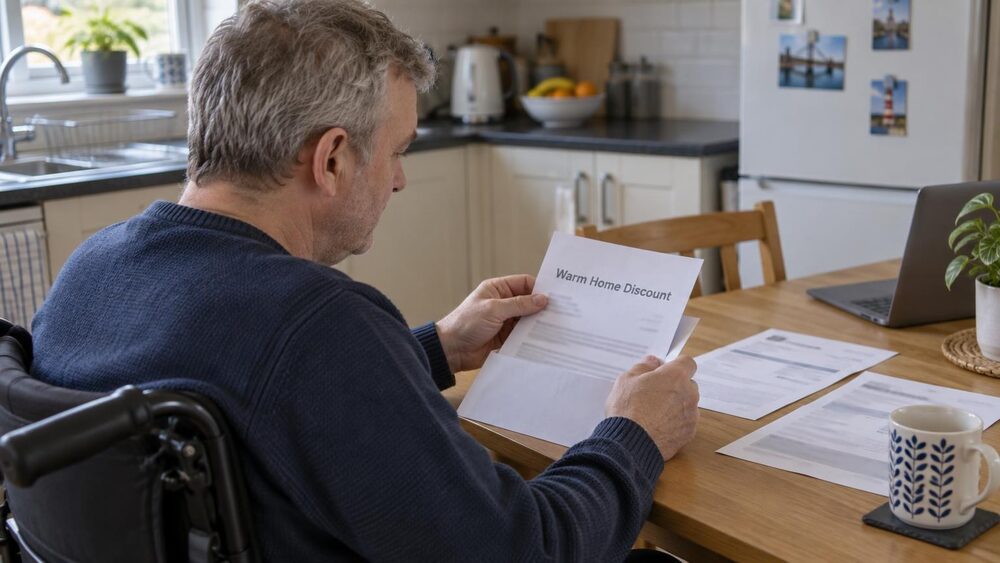
Changes to the Warm Home Discount are due to come into force in November 2022 and will remove entitlement to the discount from nearly 200,000 disabled people, according to research published by the disability charity Sense with the National Centre for Social Research1. The government announced the changes in August 2022; they remove eligibility for anyone in receipt of disability benefits who does not also claim an income-replacement benefit1.
The change lands in a winter in which energy support has already been reshaped. Ofgem announced in February 2022 that the energy price cap, the maximum amount energy providers can charge consumers, would rise to £1,971 a year from April, an increase of 54%. In late August it announced a further rise due to take effect from October, which would have increased the cap by 80% to £3,549 a year1. The Energy Price Guarantee, a subsidy announced by the government, instead keeps the annual cost of energy for a household with average levels of consumption at £2,500 for the two years from October 20221.
Alongside the guarantee, the government announced a £400 discount to energy bills for winter 2022-23, a £150 council tax rebate for homes in bands A to D in England, payments totalling £650 for people receiving income-related benefits, a £150 one-off payment for people receiving disability benefits, and a £300 one-off payment for people who qualify for a Winter Fuel Payment1.
Sense's analysis of the 2020-21 wave of the Family Resource Survey found that, among people of working age, almost a quarter (24%) of people with complex disabilities were unable to keep their home adequately warm, compared with 8% of those with a different disability and 3% of those with no disability. Seven in ten (69%) had less than £1,500 in savings, against 53% of people with another disability and 33% of those with no disability. Only 13% were in full-time work, and nearly a third (29%) were drawing on support from Universal Credit1. The study defines someone as having complex disabilities if they have two or more of sight loss, hearing loss, autism and learning disability, and report that their life is impacted by their disabilities1.
| Group | Unable to keep home adequately warm | Less than £1,500 in savings | In full-time work |
|---|---|---|---|
| People with complex disabilities | 24% | 69% | 13% |
| People with another disability | 8% | 53% | 31% |
| People with no disability | 3% | 33% | 58% |
Source: Sense and NatCen, October 20221
"These changes, due to come into force in November 2022, will remove entitlement to the discount from nearly 200,000 disabled people"
Why it matters for households
For households that include someone receiving a disability benefit such as Personal Independence Payment but no income-replacement benefit such as Universal Credit, the discount is withdrawn from November 2022 under the announced changes1. The £150 one-off payment for people receiving disability benefits, announced as part of the wider cost of living package, is separate from the discount1.
The research also records wider financial pressure among disabled households before the current energy price rises: disabled people generally were three times more likely (13%) to be behind on bills or debts than those with no disability (4%), and three times more likely to be food insecure (17% against 5%)1. Adults in households with disabled children were more likely to have savings below £1,500 (60%) than those in households with children with no disability (42%)1.
The Warm Home Discount and other help with energy bills guide sets out how the scheme and related support work, and the benefits section covers the wider system.
What happens next
The eligibility changes take effect in November 20221. Sense states that at the time of writing the government had not committed to uprating benefits in line with inflation in spring 2023, and notes that the standard rate of Universal Credit has risen by 7.5% since 2013 while inflation has risen by 22.9% over the same period1.
 Turn2usFree benefits calculator and grants search from a charity
 Citizens AdviceFree advice on money, consumer and legal problems in England and Wales
 GOV.UKOfficial information on tax, benefits and government services
 MoneyHelperFree, impartial money and pensions guidance, set up by government