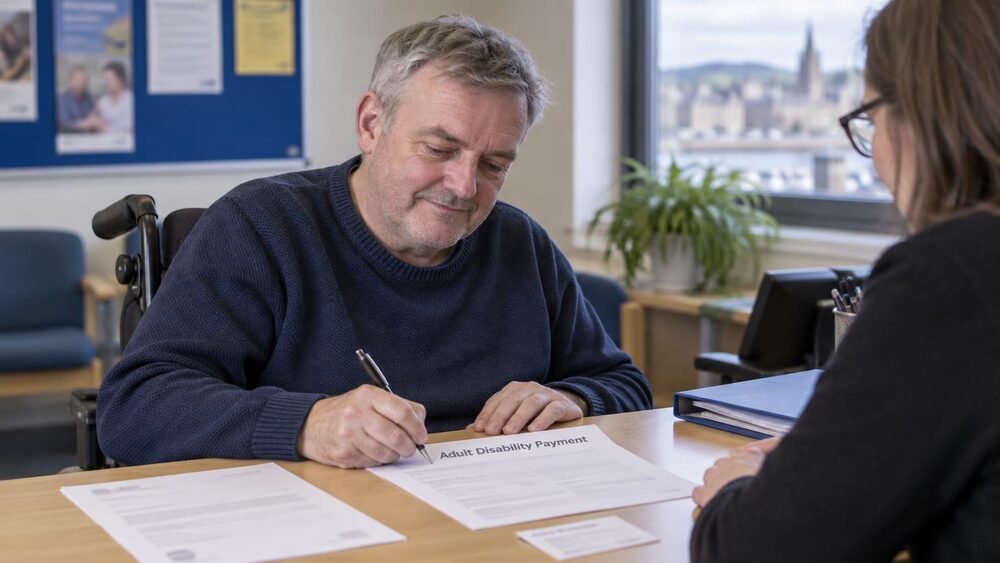
Adult Disability Payment (ADP) was introduced in Scotland from March 2022, replacing Personal Independence Payment (PIP) and Disability Living Allowance (DLA) for people aged 16 to State Pension age1. The pilot ran from March 2022, with full roll-out from August 20221.
ADP is one of a series of benefits devolved to the Scottish Government. The same statistical release sets out the transfer timetable for each: Child Disability Payment replaced DLA for children from July 2021, with full roll-out in November 2021; ADP replaced PIP and DLA for working age adults from March 2022, with full roll-out in August 2022; Scottish Adult DLA followed in March 20251. Carer's Allowance was devolved earlier, with administrative responsibility transferring to the Scottish Government in September 20181.
| Scottish payment | Replaces | Pilot start | Full roll-out |
|---|---|---|---|
| Child Disability Payment | DLA (child) | July 2021 | November 2021 |
| Adult Disability Payment | PIP and DLA (working age) | March 2022 | August 2022 |
| Scottish Adult DLA | DLA (working age and State Pension age) | March 2025 | Not stated |
Source: Benefit Combinations: Official Statistics to March 20261
Because these benefits are devolved, they are not counted in the DWP benefit combination statistics. The release states that "Figures for Scotland are impacted by devolution of some benefits to Social Security Scotland. Devolved Scottish benefits CDP, ADP, Scottish Adult DLA, CSP, CAS or PADP are not included as part of this release"1.
"ADP | PIP & DLA ( WA ) | March 2022 | August 2022"
The same release records that in March 2026, 24.5 million people claimed some combination of the 17 DWP benefits covered, the highest level since the series began in 20131. Of these, 13.5 million were of State Pension age, 10.1 million were of working age and 900,000 were under 16 and in receipt of DLA as a child1. In Scotland there were 1.8 million claimants: 1.1 million of State Pension age and 800,000 of working age1. The release notes that fewer than 100 people in Scotland were under 16 and in receipt of DLA as a child, reflecting the move to Child Disability Payment1.
Why it matters for households
For a household in Scotland with a disability or health condition, the benefit that pays for extra costs changed from PIP or DLA to ADP, starting with the March 2022 pilot and covering all areas from August 20221. Claims are administered by Social Security Scotland rather than the Department for Work and Pensions, and ADP claimants are not included in the DWP benefit combination figures1.
The split matters for people who move across the border. The DWP statistics are published separately for England and Wales and for Scotland precisely because certain benefits are devolved1. Someone whose award transfers between the two systems falls outside the single set of combination figures, and the release does not set out how awards are treated on a move.
The figures also show how the claimant population has changed. The total number of DWP benefit claimants rose from around 20.0 to 21.0 million between February 2013 and February 2020, peaked at 23.0 million in February 2021, fell to 22.4 million by February 2022 and has since risen to 24.5 million in March 20261. The release states that the increase in working age claimants cannot be explained by transitions from legacy benefits to other benefits1.
What happens next
The release records further Scottish changes from March 2026: the Scottish Government will introduce a Carer Additional Person Payment, an additional payment for someone caring for more than one person in receipt of a qualifying benefit, and will replace Carer's Allowance Supplement with Scottish Carer Supplement1. Pension Age Disability Payment replaced Attendance Allowance from October 2024, with full roll-out in April 2025 and completion in winter 20251. Carer's Allowance devolution ran from November 2023, with full roll-out in November 2024 and completion in autumn 20251.
 Turn2usFree benefits calculator and grants search from a charity
 Citizens AdviceFree advice on money, consumer and legal problems in England and Wales
 GOV.UKOfficial information on tax, benefits and government services
 MoneyHelperFree, impartial money and pensions guidance, set up by government