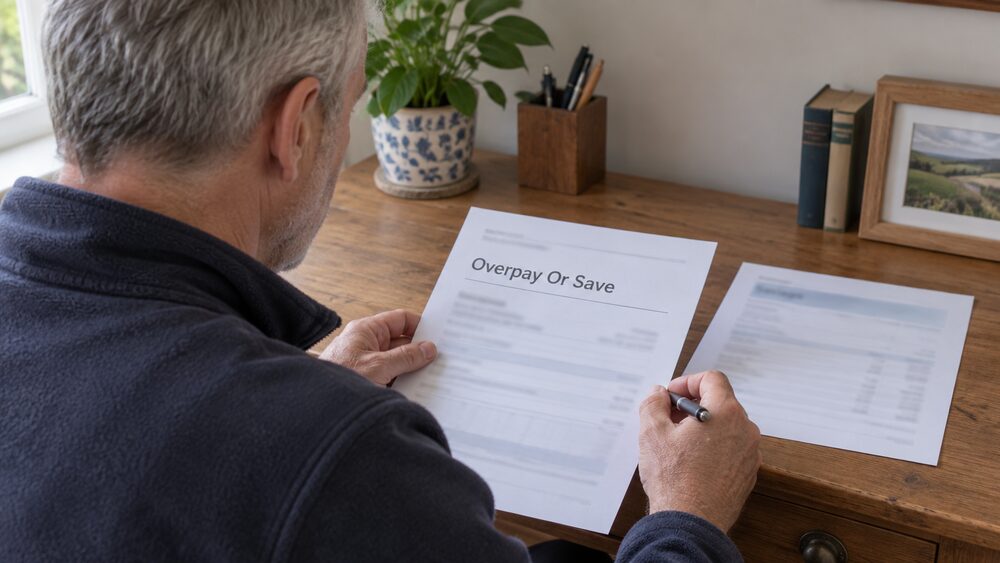
A mortgage overpayment is an extra payment on top of your standard monthly mortgage payment1. It reduces the balance you owe, so you pay less interest, and if you keep up your normal monthly payment as well, it can shorten your term and bring the day you are mortgage-free forward1.
Most mortgages let you overpay a certain amount, usually around 10% a year, without incurring any additional charges2. That allowance is the single most important number to check before you pay anything extra, because going over it can trigger an early repayment charge3. The saving you make by overpaying is not taxed4, while interest on savings above your Personal Savings Allowance is taxed at your usual rate of Income Tax5.
So the choice is not simply "which rate is higher". It is a trade-off between a guaranteed, tax-free reduction in debt and keeping money accessible in a savings account that may be taxed. What follows sets out what overpaying does, what it costs, the limits that apply, and how the tax rules change the comparison.
What overpaying a mortgage means
An overpayment is simply paying a bit extra on top of your usual monthly payment7. On a repayment mortgage, where each monthly payment covers both the capital borrowed and the accrued interest8, that extra money goes straight against the capital you owe1. Every time you overpay, you are paying off more of the capital, which reduces your mortgage balance1. With a lower balance, the amount of interest you owe goes down too1.
The effect is different on an interest-only mortgage, where your monthly payment covers interest but not the capital. Any overpayments you make still reduce the outstanding balance, which means the final payment you need to make to repay the loan is smaller and you pay less interest over the life of the mortgage1. If you are on interest-only and want to overpay, you need to switch to a repayment mortgage to do this9.
Some lenders hold your overpayments in what is called an overpayment reserve. An overpayment reserve is what you create when you overpay your mortgage10. All overpayments go into the reserve, and the reserve is used to reduce the interest you pay on your mortgage balance11. Depending on when you took out your current mortgage deal, that reserve could allow you to pay off your mortgage earlier, underpay on your mortgage, or borrow back the overpaid amount10.
Overpaying cuts the term and the total interest
Making overpayments means you will repay your mortgage quicker and pay less interest in total12. As the balance reduces more quickly, your original mortgage term may shorten, enabling you to finish paying off your mortgage earlier13. Regular overpayments could help you become mortgage-free earlier if you maintain your normal monthly payment as well as your overpayment1.
The size of the effect depends on how much you overpay and for how long. One worked example: an overpayment of £100 a month on a £200,000 mortgage could enable you to shave three years off the term and save as much as £10,000 in interest14. That is an illustration from 2021, and the actual saving on any mortgage depends on its rate and remaining term, but it shows the scale of what a modest regular overpayment can do over time.
There is a second, less certain benefit. Overpaying may mean that if you come to remortgage in the future, you might be able to choose from mortgages with lower interest rates because you would have a smaller loan-to-value ratio and more equity in your home, but it is not guaranteed1. A lower loan-to-value ratio is simply the size of your loan measured against the value of your home15, and lenders price deals partly on that measure.
Limits, minimums and early repayment charges
Most mortgages have a limit or a maximum amount you can overpay before incurring an early repayment charge18. The typical allowance is around 10% of the balance each year2, and most fixed-rate mortgages allow you to overpay up to 10% of the balance each year, either in regular overpayments or on an ad-hoc basis3. Overpaying more in a 12-month period may trigger an early repayment charge3.
The detail matters, because lenders define the allowance differently. Some run it by calendar year: one lender allows overpayments of up to 10% of your fixed rate loan amount each calendar year, January to December, without paying an early repayment charge19. Others express it as a percentage of the original loan amount rather than the current balance, and some products restrict overpayments to a maximum of 10% of your original loan amount before incurring an early repayment charge20. Some lenders, but not all, let you overpay by up to 10% each year without a fee21.
| What the rule covers | Typical position | What to check |
|---|---|---|
| Annual allowance | Around 10% of the balance a year2 | Whether it is the balance or the original loan20 |
| Period measured | Calendar year with some lenders19 | Whether your deal year differs |
| Going over the limit | Early repayment charge may apply22 | The charge in your mortgage offer6 |
| Repaying in full early | Charge during the initial product period6 | When your product period ends |
An early repayment charge is a fee you may have to pay if your mortgage is repaid or transferred during the initial product period, or if you overpay more than the maximum allowed6. If you are still in your initial fixed or tracker period, you may be charged an early repayment charge for overpaying23. Some mortgages have no limit at all on overpayments, though early repayment charges may still apply24.
Check your lender's terms before you overpay
Make sure you check if your mortgage deal has overpayment limits or early repayment charges15. Customers should check their mortgage offer for any overpayment limits and early repayment charges25. Always check with your lender as fees may be involved when overpaying26. Depending on your mortgage product, there may be restrictions on the maximum amount you can overpay in one year without having to pay an early repayment charge27.
The practical steps are straightforward. Find your mortgage offer or your lender's current terms, identify the annual overpayment allowance and how it is measured, and confirm whether an early repayment charge applies during your current deal period. If you are on a fixed rate, the allowance is usually stated as a percentage of the balance3. If you are on a tracker or another product, the position can differ: for some mortgage products there may be a limit to the amount you can overpay by and an early repayment charge could apply28.
If you choose to make a lump sum payment, one lender's terms illustrate how the mechanics work: an early repayment charge may apply if the payment is made within the period that early repayment charges apply, and the borrower must confirm the payment is to repay the mortgage and should reduce the interest-charged balance29. In other words, tell your lender what the money is for, so it is applied to the balance rather than sitting unallocated.
Will overpaying reduce my monthly payment or shorten my mortgage?
This is one of the most common points of confusion, and the answer depends on your lender and on what you tell it. Regular overpayments could help you become mortgage-free earlier if you maintain your normal monthly payment as well as your overpayment1. That is the route that shortens the term.
Some lenders instead reduce your payment. For single overpayments of £500 or more, one lender automatically reduces your minimum monthly payments the following month, unless you have already changed your preference11. If your aim is to shorten the term rather than lower the monthly bill, that is a preference worth setting with your lender in advance.
If you are struggling rather than overpaying, the options run the other way. Lenders may reduce your payments for a set period, charge interest only for a while on a repayment mortgage, give a payment holiday, or extend the mortgage term to reduce payments, depending on your payment history and whether your difficulties are long or short term30. These options can reduce your monthly payments now, but they cost more over the lifetime of the mortgage31. A payment holiday does not write anything off: you still have to pay off the whole mortgage, either by increasing your monthly payments afterwards or by extending the mortgage term32.
Can I get overpaid money back if I need it later?
With some lenders, yes. An overpayment reserve is what you create when you overpay your mortgage10, and depending on when you took out your current mortgage deal, that reserve could allow you to pay off your mortgage earlier, underpay on your mortgage, or borrow back the overpaid amount10. That flexibility is the main argument for overpaying with a lender that offers a reserve, rather than treating the money as gone.
With other lenders, an overpayment is simply a permanent reduction of the balance, and the money is not available again. That is why the reserve question belongs in your checks before you pay, alongside the allowance and any charge.
There is a parallel in other areas of borrowing that shows how much difference the terms make. Overdrafts are repayable on demand, which means a bank can ask you to pay the whole amount back in one go if it chooses to33. A mortgage overpayment held in a reserve is not repayable on demand in the same way, but the lesson is the same: the terms of the account decide what you can get back and when.
If you are considering overpaying but might need the money for something else, the reserve terms are the deciding factor. If your lender does not offer one, the money you overpay is committed to the mortgage.
Do I have to pay tax on savings interest when comparing the two?
This is where the comparison between overpaying and saving stops being a simple rate calculation. There is no tax on the saving you make by overpaying your mortgage4. The interest you earn on savings is treated differently.
Interest on savings is usually paid gross, which means tax is not automatically deducted before interest is paid34. You pay tax on any interest over your allowance at your usual rate of Income Tax5. Any interest above your allowance is taxed at your standard income tax rate, whether that is 20%, 40% or 45%35. If you do not already complete a Self Assessment tax return, you will need to register if your savings interest is more than £10,0005.
The rates are changing. From 2027, a basic-rate taxpayer will be faced with a 22% charge, higher-rate taxpayers will pay 42%, and those in the additional rate will pay 47%36. Those figures are for a future tax year and are reported as planned changes, so they are worth checking against the position when the year arrives.
An offset mortgage changes the arithmetic again. With an offset mortgage, you will not pay any tax on savings income, or use up your Personal Savings Allowance, because you will not be earning interest on the cash37. Instead, the savings are set against the mortgage balance so you pay interest on less. As an illustration, if you have £20,000 in a savings account that is linked to an offset mortgage of £300,000, you would only pay interest on £280,00037. That structure suits higher-rate and additional-rate taxpayers in particular, because it removes the tax question altogether37.
| Route | Tax treatment | Access to the money |
|---|---|---|
| Overpay the mortgage | No tax on the saving made4 | Depends on whether your lender offers a reserve10 |
| Save in a standard account | Taxed above your Personal Savings Allowance38 | Accessible |
| Offset mortgage | No tax on savings income and no use of the allowance37 | Set against the balance |
Is it better to overpay my mortgage or put the money in savings?
There is no universal answer, and the facts point in different directions depending on your circumstances. Overpaying gives a guaranteed reduction in the interest you owe, and the saving is not taxed4. Saving keeps the money available and earns interest, but interest above your Personal Savings Allowance is taxed at your usual rate5, and the rates are set to rise from 202736.
The factors that decide it are your mortgage rate, your savings rate, your tax band, and whether you might need the money. A higher-rate taxpayer with savings above the allowance faces a bigger tax drag on the savings route than a basic-rate taxpayer with savings inside the allowance. Someone who may need the money for repairs, a move or an emergency gets more from a savings account, or from a lender that offers an overpayment reserve10.
What overpaying cannot do is help if you have no cash buffer. Money paid into a mortgage is hard to get back unless your lender offers a reserve, and the terms of that reserve depend on when you took out your deal10. Keeping accessible savings alongside any overpayment is the arrangement that leaves both options open.
Where the protection stops
The rules that protect you when you overpay are mostly about disclosure and limits rather than compensation. Your lender must set out the overpayment allowance and any early repayment charge in your mortgage offer25, and the charge itself is defined as a fee you may have to pay if your mortgage is repaid or transferred during the initial product period, or if you overpay more than the maximum allowed6. If you think a charge has been applied wrongly, or that the terms were not explained, you can complain to your lender and then to the Financial Ombudsman Service.
What protection does not do is make overpaying reversible. If your lender does not offer an overpayment reserve, the money is committed, and the only way to access it is to borrow again, which means a new application and a fresh affordability check. Lenders need to check whether you can afford to repay before you take out an agreement40, and that applies to borrowing back money you have already paid as much as to any new loan.
The tax position is also outside any protection. Interest on savings is paid gross and you are responsible for paying the right tax on it34, including registering for Self Assessment if your interest is more than £10,0005. Nobody will do that check for you.
Sources40 cited
- Overpaying your mortgage: what is involved Leeds Building Society, 2025-11-20
- How do mortgage payments work Which?, 2026-06-19
- Fixed rate mortgages Which?, 2026-04-02
- When to save, when to invest and when to overpay your mortgage Which?, 2026-02-23
- How you pay tax on savings interest GOV.UK, 2026-09-28
- Mortgage glossary Cambridge Building Society, 2026-09-26
- Overpaying mortgage payments Yorkshire Building Society, 2026-09-26
- Mortgage jargon buster StepChange, 2026-09-25
- Options if you cannot pay off your interest only mortgage Shelter England, 2025-09-15
- Overpayment reserve Nationwide, 2026
- Overpayments Nationwide, 2026
- Overpayment calculator Experian, 2026
- Paying your mortgage off early HSBC UK, 2026-09-24
- Over half of borrowers will still have a mortgage at 65 Which?, 2021-09-26
- What is loan to value ratio Lloyds Bank, 2026-09-27
- How to get a mortgage Building Societies Association, 2023-01-19
- How can I stop living in my overdraft StepChange, 2026-09-25
- Mortgage repayment guide RBS, 2026-09-25
- Types of mortgage explained Santander, 2026-09-25
- Mortgage FAQ Leek Building Society, 2026-09-25
- Ten year fixed rate Experian, 2026
- Bank of England base rate changes and your mortgage Nationwide, 2026
- Your interest only mortgage Kensington Mortgages, 2026-09-26
- Repayment first direct, 2026
- A guide for new mortgage customers Cambridge Building Society, 2026-09-26
- What is negative equity Lloyds Bank, 2026-09-27
- Mortgage overpayments calculator Skipton Building Society, 2026-09-26
- Interest only Skipton Building Society, 2026-09-26
- Residential mortgages Precise Mortgages, 2026-09-26
- Mortgage arrears or payment difficulties nidirect, 2025-11-07
- How to deal with missed mortgage payments Shelter England, 2026-08-26
- Mortgage payment holidays StepChange, 2026-09-25
- Debt consolidation National Debtline, 2026-09-25
- 7 surprising reasons you might need to file a tax return in January Which?, 2025-01-08
- One million more people set to pay income tax Which?, 2026-07-31
- Half a million savers face a tax bill over £2,000 Which?, 2027
- Offset mortgages Which?, 2026-04-02
- Are ISAs still worthwhile Which?, 2026-04-06
- Mortgage underfunding Financial Ombudsman Service, 2026-09-26
- Buy now pay later Financial Conduct Authority, 2026-07-15






 MoneyHelperFree, impartial money and pensions guidance, set up by government
 StepChangeFree debt advice and solutions from a charity
 Financial Ombudsman ServiceFree, independent help when a complaint about a firm is not put right
 Citizens AdviceFree advice on money, consumer and legal problems in England and Wales
 ShelterFree housing advice from a charity