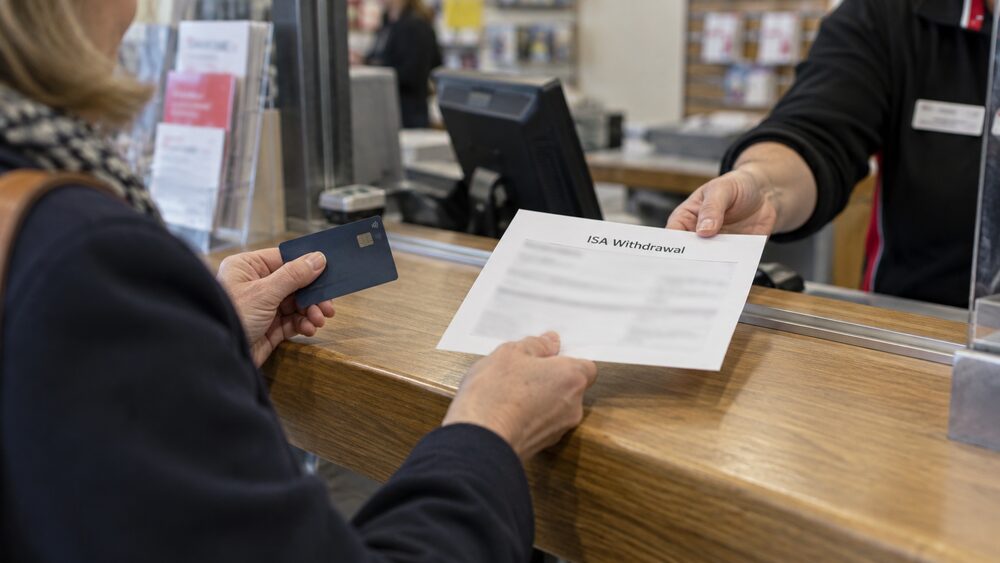
An ISA, or Individual Savings Account, is a type of savings account where you do not have to pay tax on the interest or returns your savings earn1. You can put up to £20,000 into cash and/or stocks and shares ISAs each tax year, and any income generated can grow completely tax-free2. The money is not locked away: in most cases you can usually take some or all of it out whenever you want3.
How a withdrawal works depends mainly on the type of ISA you have. Easy access and instant access cash ISAs, and most stocks and shares ISAs, let you withdraw at any time without a charge. Fixed rate cash ISAs usually impose a penalty, or refuse early access altogether. Lifetime ISAs have their own special rules, with a withdrawal charge in most circumstances, and Junior ISAs cannot normally be touched at all until the child turns 18.
Two rules matter more than any other when you take money out. First, money that leaves an ISA loses its tax-free status. Second, unless your ISA is a flexible ISA, paying that money back in uses up part of your annual allowance. Both are explained below, along with how long withdrawals take, what to do when moving between providers, and what happens to an ISA when the holder dies.
Most ISAs let you take money out at any time
For most people, the answer to "can I take money out?" is yes, whenever you like. Royal London's guidance is that with an easy access cash ISA, "you can withdraw money at any time", and that the interest rate on these accounts is normally variable, so it can change3. Skipton Building Society describes its Easy Access Cash ISA in the same terms: withdraw anytime9. RBS says of its Instant Access ISA simply that you can take money out whenever you need it10.
The same freedom generally applies to investment ISAs. Monzo states of its stocks and shares ISA that "yes, you can withdraw money at any time"11. Legal & General's guidance puts the general position well: "In most cases, your money is not locked in, you can usually take some or all of it out whenever you want"12.
The exceptions are where a product's terms say otherwise. NS&I's ISA guidance notes that with a fixed rate cash ISA, "you usually can't withdraw money during the fixed term without penalty, unless the product rules allow it"7. Leek Building Society says the same from the provider's side: typically, fixed rate cash ISAs do not allow withdrawals during the fixed term without a penalty or losing some or all of the interest earned13. Virgin Money's M Fixed Rate ISA sits in between: you can take all or part of your money out before the end of the fixed term, but there will be a charge14. Which? adds that fixed-rate accounts may charge an interest penalty if you withdraw money or close the account before the fixed period ends15.
Two other types of ISA have their own withdrawal rules entirely:
- Lifetime ISAs allow withdrawals at any time, but a withdrawal charge applies unless the money is used to buy a first home, or the withdrawal happens after you turn 60, you become terminally ill, or you die. The charge and the exceptions are covered in detail on the Lifetime ISA withdrawal charge page.
- Junior ISAs are held in the child's name and normally cannot be withdrawn from before their 18th birthday. See Junior ISAs explained and can money be taken out of a Junior ISA before 18?.
If you are not sure which type you hold, the account name on your statement or the provider's app will say. The practical rule of thumb: variable rate and easy access accounts are built for withdrawals, fixed rate accounts are built for leaving alone, and Lifetime and Junior ISAs follow their own rulebooks.
Money taken out loses its tax-free status
The tax-free treatment of an ISA belongs to the money while it is inside the ISA, not to you as a person. Which?'s guidance states it plainly: "If you take money out of an Isa, it loses its tax-free status"5. Legal & General tells its own ISA investors the same: "withdrawing your money or closing your account will cause you to lose the ISA tax benefits in relation to the money that" was withdrawn16.
In practice this means that once your money is sitting in an ordinary savings account or current account, it is taxed like any other savings. Interest it earns from that point counts towards your personal savings allowance, and if you have used that allowance up, further interest is taxable. For someone with modest savings this may make no difference at all, since most people can earn some interest tax-free outside an ISA. For someone with large balances, or who expects rates to rise, it can matter a great deal.
The money that stays behind in the ISA keeps its tax-free status. So a partial withdrawal only strips the tax shelter from the amount you took out, not from the whole pot. That is why partial withdrawals are usually preferable to closing an account outright if you only need some of the money.
One point worth noting for the future: the government's planned changes to cash ISA limits from April 2027 do not affect money already inside an ISA. Which? reports that money already held in a cash Isa will keep its tax-free status, and the new limits will apply to money paid in from April 2027 onwards17. So withdrawing and re-depositing after that date could be a very different calculation from leaving the money where it is. The full detail is on changes to the cash ISA limit.
How withdrawals affect your £20,000 allowance
The annual ISA allowance is £20,000 per tax year4. You can split it across multiple types of ISA, but you cannot exceed it in total new deposits across everything you pay in during the year. The key point for withdrawals is this: taking money out does not give you extra allowance, and unless your ISA is flexible, putting money back in counts as a fresh deposit against the £20,000.
NS&I's guidance gives a clear example of how the allowance works between years: "Your ISA allowances do not roll over, so if you deposit £10,000 one year, you cannot deposit £30,000 the next year to make up for it"6. The same logic applies within a year. If you deposit £20,000, withdraw £5,000 and then pay the £5,000 back into a non-flexible ISA, you have deposited £25,000 in total and exceeded the limit, even though your balance is only £20,000.
interactive investor's transfer guidance describes the mechanism from the other direction: when you withdraw money from an ISA, it loses its tax-efficient status, and if you then add it to a different ISA it counts towards the annual ISA allowance18. So a withdrawal followed by a re-deposit into another ISA is treated exactly the same as new money.
The Lifetime ISA has an explicit version of this rule. HMRC's technical note states that "if individuals withdraw money from a Lifetime ISA, this will not increase the amount that they are able to pay into a Li[fetime ISA]" in that year19. In other words, withdrawing does not create room, even though Lifetime ISA withdrawals are usually subject to the government's withdrawal charge on the way out.
Two changes are coming that make this section more important than it used to be. From April 2027, the amount under-65s can pay into cash Isas will be cut to £12,000 a year, as Which?'s cash ISA rules guide reports20. Which?'s news coverage of the same change describes the allowance on cash ISAs being cut "from £20,000 down to £12,000 for under-65s", due to come into effect from April 20278. Under those rules, a withdrawal and re-deposit that would have been harmless in an earlier year could use up a much larger share of your cash ISA room. The deadline itself, and what to do before 5 April, is covered on the ISA deadline and the end of the tax year.
Flexible ISAs: putting money back in the same tax year
A flexible ISA solves the allowance problem described above. The government's consultation on the 2016 ISA regulations defines it precisely: a flexible ISA "allows savers to replace cash they have withdrawn from their account earlier in a tax year, without this replacement counting towards the annual ISA limit for that year", where the provider's terms and conditions provide for it21. NS&I's plain-English version: a flexible ISA is a type of ISA, cash or stocks and shares, that allows you to withdraw money and pay it back in again within the same tax year without it affecting your ISA allowance7.
The conditions are strict, and both official and independent sources agree on them:
- The money must go back into the same account it came out of.
- It must be repaid in the same tax year as the withdrawal.
- The provider must offer flexibility: it is not obliged to. Which? notes that not all providers allow flexible withdrawals22, and the government's consultation makes flexibility available only "where provided for in the terms and conditions of a 'flexible ISA'"21.
- Flexibility applies to both current year and earlier years' ISA savings, again where the terms allow21.
How a flexible ISA and a standard ISA treat money you withdraw and then pay back in.
Which?'s end-of-tax-year advice summarises the effect: "Flexible Isas allow you to withdraw funds and replace them in the same tax year without affecting your allowance"24. Nationwide applies the rule to its own accounts: you can withdraw money from your cash ISA and replace it within the same tax year without it counting towards your annual ISA allowance, which it calls ISA flexibility25.
Providers state flexibility in their product documents. Moneyfarm's cash ISA key information document says you can "repay withdrawn money in the same tax year without affecting your annual ISA allowance (flexible ISA)"26. Virgin Money's M Access ISA is a flexible ISA: you can replace money taken out without impacting your annual ISA allowance, and money put back must go into the same account in the same tax year it was taken out14. Triodos, by contrast, describes the non-flexible case: if you choose to re-add money that you have withdrawn from an ISA, you will use up a portion of an ISA allowance, unless the account is flexible23.
The practical value of flexibility is easiest to see with an example built from the figures above. Suppose you have £20,000 in a cash ISA and need £3,000 for an emergency in October. In a flexible ISA you can take out £3,000 and put it back in by the following 5 April, and your allowance is untouched. In a non-flexible ISA, the £3,000 you pay back uses £3,000 of that year's allowance, on top of whatever you deposited when you first funded the account. If you had already used your full £20,000, you could not put the money back at all until the new tax year. The full detail, including how to check whether your account is flexible, is on flexible ISAs.
Withdrawing from a stocks and shares ISA
Withdrawing from a stocks and shares ISA adds one step to the process: the investments have to be sold first. You ask the provider to sell some or all of your holdings, and once the sale has settled, the cash can be paid out to you or held inside the ISA. Monzo confirms that with its stocks and shares ISA you can withdraw money at any time11, and Legal & General's general guidance is that money in these ISAs is usually not locked in12.
Where the money goes is worth knowing in advance. interactive investor states: "You can withdraw money from your ISA into an account held in your name"27. So the destination is your own bank or building society account, not a third party's.
Two things to weigh before selling investments to withdraw:
- Selling crystallises the position. The tax consequences inside an ISA are neutral, since ISA holdings are free of tax on their returns. But once the cash is withdrawn, any future growth on it happens outside the ISA's shelter.
- Market timing. The value of investments can fall as well as rise, so the amount available depends on what the holdings are worth when you sell. That is a general property of investment ISAs, not a withdrawal rule.
There is also a rule change coming that affects the direction of travel between ISA types. Since 2014, the ISA regulations have permitted transfers from stocks and shares ISAs into cash ISAs: the 2014 regulations revoked the previous prohibition, "so as to permit transfers from stocks and shares ISAs to cash ISAs"28. But HMRC's Tax-free Savings Newsletter 22 states that from 6 April 2027, "transfers from non-cash ISAs into cash ISAs will not be permitted"29. Which?'s coverage describes this as a ban on transfers from stocks and shares ISAs to cash ISAs8. After that date, the only way to move money from an investment ISA to a cash ISA will be to withdraw it, which loses the tax-free status and may use allowance to re-deposit. Anyone planning such a move has a window in which the transfer route remains open. See stocks and shares ISAs explained and how to transfer an ISA.
How long a withdrawal takes to arrive
There is no single standard: each provider sets its own timescales, and the method you use matters. The clearest published examples:
| Provider and account | Stated timescale |
|---|---|
| NS&I Direct ISA | withdrawals can take 3-5 days to reach your bank account30 |
| NS&I Direct Saver (for comparison) | 3-5 days to reach your bank account31 |
| NS&I, online or phone, up to £50,000 | normally reaches your account by the end of the first banking day after the instruction is received32 |
| NS&I, by post, up to £50,000 | processed on the next banking day, then normally two banking days32 |
| NS&I, phone, over £50,000 in total in one day | normally between two and four banking days32 |
| interactive investor stocks and shares ISA | before 2pm, usually next working day; after 2pm, within two working days27 |
| Moneyfarm Cash ISA | withdrawals may take up to three working days to process26 |
| Lifetime ISA (HMRC policy) | account holders should usually be able to withdraw within 30 days of requesting19 |
The NS&I figures show how much the method matters within a single provider: the same institution quotes anything from the next banking day to five days depending on whether you use its website, the phone or the post, and on the size of the payment32. Larger withdrawals face extra checks, which is why payments above £50,000 in a day take longer.
For a stocks and shares ISA, add the time for investments to be sold and settled before the cash can be sent. interactive investor's next-working-day and two-working-day timescales apply to a cash withdrawal once requested27.
If money does not arrive within the provider's stated timescale, contact it first and, if the matter is not resolved, follow the complaints route described at the end of this page. Where a withdrawal is delayed because of a transfer between providers rather than a payment to you, there is a separate route to redress, covered on compensation if my ISA transfer is delayed.
Moving your ISA? Transfer it, don't withdraw it
This is the one situation where taking money out is almost always the wrong move. Money saved in previous years can be shifted from ISA to ISA, switching provider, without losing the tax breaks33. But that only works if you use the proper transfer process. If you withdraw the money yourself and then deposit it with the new provider, the money has left the ISA wrapper, lost its tax-free status, and the re-deposit uses part of your current year's allowance.
Providers are unusually unanimous on this point. Nationwide tells its savers: "To transfer your ISA and its entire balance to another ISA, either with us or another provider, you need to follow our ISA transfer process. Do not just withdraw the money as you may lose your tax-free status"25. Leek Building Society: "Please don't close your account yourself and transfer the money to your new provider, as you'll lose your tax-free statu[s]"13. Triodos: "Do not move funds out of an ISA yourself, because your money will lose this ISA status"23. Which? gives the same warning for innovative finance ISAs: "Don't withdraw your money out of your other Isas to transfer, as it could impact on your current Isa allowance"34.
The correct way to move an ISA: the new provider arranges the transfer and the money never leaves the ISA wrapper.
The process itself is straightforward: you open the new ISA, tell the new provider you want to transfer in, and it contacts the old provider directly. interactive investor's guidance says a transfer typically takes up to four weeks as a cash payment, and around six weeks for existing investments18. Transfers do not use up your annual allowance, a point covered in full on does transferring an ISA use my allowance?.
Things can still go wrong. Which? has reported on cases where stocks and shares ISA transfers go wrong, with money leaving the old provider and not arriving at the new one, leaving the saver's money outside the ISA wrapper in the meantime35. If that happens, complain to the provider at fault; the route is described under complaining about an ISA provider. The step-by-step process, including partial transfers, is on how to transfer an ISA and can I transfer part of my ISA?.
What happens to an ISA when the holder dies
When an ISA holder dies, the account does not simply continue as before, and the tax treatment depends on who inherits and when the death occurred.
For deaths on or after 6 April 2018, the rules changed in the surviving spouse's or civil partner's favour. The Building Societies Association explains that where a person holding an ISA dies from 6 April 2018, additional ISA allowances became available to the spouse or civil partner36. Under the old rules, if a saver with an ISA died, the tax benefits fell away on death and the holdings were added to the estate36. NS&I puts the practical effect simply: "You can now inherit an additional ISA allowance if your spouse or civil partner dies, up to the value of their ISA at the date of death"30. Which? describes the same arrangement: Isas can be handed to a spouse or civil partner tax-free, and they get an extra Isa allowance equivalent to the value of the Isa inherited37. This is the additional permitted subscription, covered in full on inheriting a spouse's ISA allowance.
For anyone else, inheritance tax is the key point. Which?'s guidance is blunt: "Isas aren't excluded from inheritance tax, so while widowers can inherit their partners' Isas tax-free, for ev[eryone else]" the Isa forms part of the estate5. Which?'s Lifetime ISA versus pension guide states the same rule from the other side: if inherited by anyone other than a spouse or civil partner, Isas are included as part of the estate for inheritance tax calculations37.
There is also a time limit on the deceased's ISA continuing. Macmillan's guidance notes that once it has been 3 years and 1 day since the date of death, the ISA provider will close the ISA38. The same guidance confirms the inheritance rule in plain terms: your husband, wife or civil partner can inherit your ISA allowance if you die38.
Lifetime ISAs have their own death rules. GOV.UK states: "If you die your Lifetime ISA ends on the date of your death. There's no charge to withdraw the funds or assets from your account"39. HMRC's policy statement lists the circumstances in which a Lifetime ISA withdrawal is free of the government charge: after the account holder reaches 60, becomes terminally ill, or dies40. A parliamentary report on the Lifetime ISA confirms that a saver who is terminally ill, with less than 12 months to live, can withdraw the full balance without charge41. The detail is on what happens to a Lifetime ISA when I die? and charge-free Lifetime ISA withdrawals if terminally ill.
The full picture, including what the estate's executors need to do, is on what happens to an ISA when someone dies.
Where to get help
If a withdrawal goes wrong, the first step is always to complain to the provider directly. It has eight weeks to give a final response, and if you are not satisfied, you can take the complaint to the Financial Ombudsman Service, which is free. The process is set out on complaining about an ISA provider.
For questions about whether a withdrawal has been handled correctly, or whether an ISA subscription broke the rules, HMRC's ISA guidance and the provider's own terms are the authoritative sources, and the repair process for mistakes is covered on when an ISA subscription breaks the rules. For general, free guidance on savings decisions, MoneyHelper, the government-backed money guidance service, is available to everyone, as are the guides in this section, including how an ISA works, ISA fees and charges and ISAs and tax: what is tax free and what is not.
Which?'s savings advice suggests the questions worth asking before opening any account, including how you would get money out in an emergency42. That is the right instinct: the time to check a withdrawal rule is before you need the money, not after.
Sources42 cited
- Saving your extra money, NS&I guide NS&I, 2026-09-22
- Half a million savers face a tax bill over £2,000 Which?, 2026-09-09
- What is an ISA and how do they work Royal London, 2026-09-26
- What to look out for when building an emergency fund Which?, 2026-06-26
- Can you inherit ISA savings tax-free? Which?, 2024-12-02
- ISA allowances campaign page NS&I, 2026-09-01
- ISA basics campaign page NS&I, 2026-09-01
- Why is the government going to tax your ISA? Which?, 2027
- How much can you put in a cash ISA Skipton Building Society, 2026-09-25
- ISA overview RBS, 2026-09-26
- Stocks & Shares ISA Monzo, 2026-09-25
- Cash vs stocks and shares ISA Legal & General, 2026-09-26
- ISA FAQs Leek Building Society, 2026-09-26
- M Access ISA and M Fixed Rate ISA key facts Virgin Money, 2026-04
- Why can't I transfer my ISA? Which?, 2025-07-07
- Important change to ISA terms and conditions Legal & General, 2026-09-26
- Will fixing your ISA beat the tax-free allowance cut? Which?, 2026-06-21
- What are the ISA transfer rules? interactive investor, 2026-09-26
- Lifetime ISA technical note, September 2016 update HM Treasury, 2016-09
- Cash ISA rules and allowances Which?, 2026-04-06
- Technical consultation: the Individual Savings Account (Amendment) Regulations 2016 HM Treasury, 2015-10-13
- Are ISAs still worthwhile? Which?, 2026-04-06
- Variable cash ISAs Triodos Bank, 2026-09-25
- 6 things to do before the end of the tax year Which?, 2025-03-07
- Ways to withdraw, savings help Nationwide, 2026
- Moneyfarm Cash ISA key information document Moneyfarm, 2026-03
- Adding and withdrawing money from an ISA interactive investor, 2026-09-26
- The Individual Savings Account Regulations 2014 (SI 2014/1450) legislation.gov.uk, 2014-07-01
- Tax-free Savings Newsletter 22, June 2026 HMRC, 2026-06
- Direct ISA NS&I, 2026-09-04
- Direct Saver NS&I, 2026-09-04
- Make a withdrawal from savings NS&I, 2025-09-01
- What is an ISA? Trustnet, 2026-09-26
- Innovative Finance ISAs explained Which?, 2026-07-08
- What happens when a stocks and shares ISA transfer goes wrong Which?, 2024-08-31
- Obtaining additional ISA allowances Building Societies Association, 2019-02-05
- Lifetime ISA vs pension Which?, 2026-03-23
- Understanding your mortgage, benefits and financial support Macmillan Cancer Support, 2022-11-01
- Withdrawing money from your Lifetime ISA GOV.UK, 2026-09-28
- Individual Savings Accounts: Lifetime ISA policy statement HMRC, 2017-02-22
- Treasury Committee report on savings House of Commons Treasury Committee, 2025-06-30
- UK Savings Week: 7 questions to ask before opening an account Which?, 2025-09-22



 MoneyHelperFree, impartial money and pensions guidance, set up by government
 FSCSProtects your money if a bank, insurer or investment firm fails
 Financial Ombudsman ServiceFree, independent help when a complaint about a firm is not put right
 GOV.UKOfficial information on tax, benefits and government services
 Citizens AdviceFree advice on money, consumer and legal problems in England and Wales