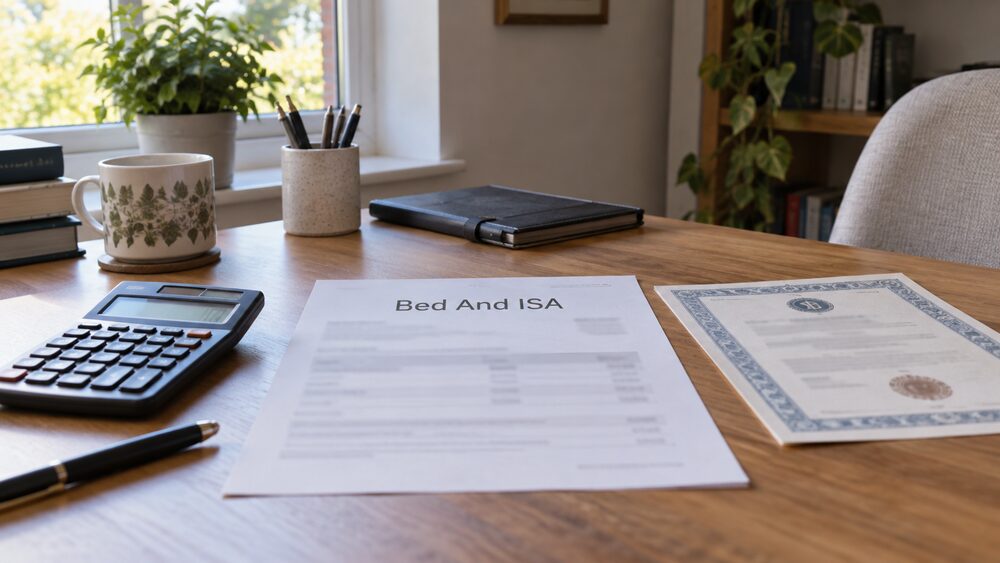
If you hold shares or funds outside an ISA and want them inside one, you cannot simply transfer them across. ISA rules do not allow it. Instead, the investments are sold in your general investment account, the cash is moved into your ISA as a normal subscription, and the same investments are bought back inside it. This pair of deals is known as a bed and ISA1.
The reason it is done this way is tax. Money and investments held in an ISA are free from UK Income Tax and Capital Gains Tax while they stay there2, so any gains and dividends after the move are sheltered. The catch is that the sale itself is a real disposal for tax purposes: if the investments have grown in value, the gain may count towards Capital Gains Tax, and the cash you subscribe uses your £20,000 annual ISA allowance3.
Bed and ISA sells and rebuys the same investments inside an ISA
A bed and ISA is a two-step transaction carried out by your investment platform. There is no direct route for moving an existing holding into an ISA wrapper: as independent guidance puts it, "If you already hold investments, you can't transfer them directly into your Isa. Instead you can opt to sell them, transfer the money to your Isa, and use that cash to buy the investments back - a pair of deals known as a Bed and Isa"1. The same process can be used to move an asset into a junior ISA or a SIPP as well as an adult stocks and shares ISA5.
In practice, most platforms that offer the service run the two legs together or close together, so you are out of the market for a short time rather than making two separate decisions. Some platforms offer discounted fees for the sell-and-rebuy pair precisely because it is a routine, mechanical transaction rather than two full trading decisions8.
Two things happen at the moment of the sale that do not happen if you simply keep holding. First, the disposal is a chargeable event for Capital Gains Tax: the difference between what you paid for the investments and what you sold them for is a gain or a loss that tax rules recognise10. Second, the cash entering the ISA is a subscription, so it uses allowance in the same way as any money you pay in from your bank account5. Both are covered in detail below.
Why people do a bed and ISA: future gains and dividends free of tax
The point of the exercise is what happens after the move. ISAs are tax exempt on interest, dividends and capital gains9, and individuals are exempt from paying tax on any income or capital gains they receive from their ISA savings and investments11. Once your shares or funds are inside the wrapper, dividends and returns on shares and bonds held in the ISA are tax-free12, and the same applies to funds held in a stocks and shares ISA, a junior ISA, a Lifetime ISA or a SIPP, where you will not pay dividend tax or capital gains tax13. Interest from corporate bonds and gilts, and from funds that invest in these assets, is also tax-free within the wrapper14.
This matters more than it used to. The annual Capital Gains Tax exempt amount has been cut sharply, from £12,300 to £3,000, and the dividend allowance has also been reduced, which official statistics identify as policy decisions that have increased the value of ISA tax relief15. The same official analysis notes these changes are a key driver behind the rising cost of ISA relief to the Exchequer16. In other words, holding investments outside a wrapper has become more likely to produce a tax bill than it was a few years ago, and that is the practical case for a bed and ISA.
A bed and ISA does not change the investments themselves. You end up holding the same shares or funds you started with; only the wrapper around them has changed. What it does not do is erase tax that has already accrued: the gain up to the point of the sale is crystallised at the moment you sell, and that is dealt with under the Capital Gains Tax rules before the ISA's protection begins10. The ISA shelter applies from the buyback onwards, not backwards.
Using your ISA allowance: up to £20,000 a year
The cash you subscribe into the ISA counts against your annual ISA allowance, which is £20,000 per year3. To make use of the bed and ISA process, you need to have some of that allowance left; if you have used it all, you need to wait until the new tax year, when your allowance renews5.
Two rules shape the timing. You cannot carry over unused ISA allowance into the next tax year, and your allowance resets every 6 April7. So a bed and ISA completed in late March uses the current year's allowance, while the same transaction in April uses the new year's. There is no partial credit for missing the deadline: the allowance is use-it-or-lose-it each year.
Allowance is not the only constraint. The bed and ISA process normally requires a stocks and shares ISA with the same provider as your general investment account5, so the £20,000 has to be available in an ISA at that provider. Money already inside an ISA is different: transferring between ISAs does not affect your allowance, as long as the providers make the transfers and the money is not withdrawn18. The distinction matters if you are juggling several accounts, and does transferring an ISA use my allowance? covers it in full.
Capital Gains Tax on the sale: the £3,000 annual exempt amount
The sale leg of a bed and ISA is a disposal, and Capital Gains Tax is a tax on the profit when you sell something that has increased in value19. You only pay it on profits above your annual exempt amount10, which is £3,000 for individuals and personal representatives, and £1,500 for most trustees4.
The exempt amount has fallen a long way in a short time. Legislation for the 2021-22 and 2022-23 tax years kept the annual exempt amount at £12,30020, and official statistics record the reduction from £12,300 to £3,000 as a deliberate policy change15. Some older guidance still quotes higher thresholds, such as an £11,100 profit limit or a £12,300 allowance21, but the figure that applies now is £3,0004.
What this means in practice is that a bed and ISA on a holding with a large built-in gain can itself create a tax bill. Suppose shares bought years ago have grown substantially: selling them realises the whole gain at once, and anything above £3,000 is taxable in that tax year. Two mitigations exist. One is spreading the move over more than one tax year, selling part of the holding before 5 April and the rest after, so two exempt amounts are available. The other is that the ISA itself then protects all future growth, which is the reason the move is worth considering despite the entry charge.
On rates: gains above the exempt amount are taxed at a rate that depends on the tax band into which the investor falls, quoted in one source as either 18 per cent or 28 per cent of the gains21. The documents in this area disagree on the basic rate, so treat any figure here as something to check against current HMRC rates for your own situation rather than a settled number.
Selling at a loss: how a loss is treated
Not every bed and ISA realises a gain. If the investments are worth less than you paid for them, the sale produces a loss, and because a bed and ISA is a genuine disposal, that loss is real for tax purposes rather than ignored. This is the flip side of the 30-day rule exception described in the next section: the sale counts, so a loss counts too.
A capital loss can normally be set against capital gains in the same tax year, reducing what is taxable, and losses that cannot be used immediately can generally be carried forward against future gains. The detail of how losses are claimed sits with self assessment, and HMRC's guidance on reporting and paying Capital Gains Tax explains what information you need: details of how much you bought and sold the asset for, the dates when you took ownership and disposed of it, other relevant details such as costs of buying and selling, and calculations for each gain or loss you report22.
Some investments have their own loss rules. If you sell Enterprise Investment Scheme shares at a loss, you can choose to set the loss amount, less any Income Tax relief already given, against your income, for the tax year of the sale or the year before23. That is a more generous treatment than an ordinary capital loss, and it survives the sale, so anyone holding EIS shares outside an ISA should check the position before selling them as part of a bed and ISA.
The 30-day rule and why a bed and ISA is different
Normally, selling shares and buying them back quickly does not achieve anything for tax. The "bed and breakfasting" rule matches shares sold against the same shares or units bought within 30 days following the day of disposal, and where the rule bites, HMRC will ignore the sale of the shares when calculating any future tax bill6. The rule exists to stop people banking a loss, or using an exempt amount, and immediately repurchasing.
A bed and ISA is a recognised exception. As independent guidance states: "You must wait 30 days before buying back the same shares (with the exception of Bed and Isa transactions, where you sell existing investments and buy them back within an Isa)"6. Because the repurchase happens inside an ISA, the matching rule does not apply, and the disposal stands.
This exception is what makes the whole process work. Without it, selling and rebuying the same shares within 30 days would be ignored for tax, and neither a gain nor a loss would be recognised. With it, the disposal is genuine: gains above the exempt amount become taxable, and losses become claimable. It also means a bed and ISA cannot be used to dodge tax on a gain, because the gain is crystallised at the point of sale, before the ISA's protection begins.
Costs: dealing charges and 0.5% stamp duty
A bed and ISA is not free. The costs fall into three groups.
The first is dealing fees. Because the process involves a sale and a purchase, a platform that charges per trade will normally charge for both legs, though some platforms offer discounted fees for selling and rebuying as part of the bed and ISA process8. Where a platform charges a percentage or a flat platform fee instead, the arithmetic differs, and ISA fees and charges covers how platform fees, fund charges and dealing costs are worked out.
The second is the buy-sell spread. Every trade is executed at two prices: you sell at the lower bid price and buy back at the higher offer price. The gap between them is a real cost of the round trip, and on lightly traded investments it can be wider than on large company shares.
The third is stamp duty. When the shares are bought back, you pay stamp duty of 0.5% on the purchase5. This applies to the buy leg only, not the sale, but it is unavoidable where the investment is UK shares. Funds, gilts and some other assets are treated differently, so the stamp duty position depends on what you are rebuying.
| Cost | When it applies | Notes |
|---|---|---|
| Dealing fees | Sale and buyback | Some platforms discount the pair8 |
| Buy-sell spread | Both legs | Wider on less-traded investments |
| Stamp duty | Buyback of UK shares | 0.5%5 |
None of these costs is large on its own, but together they set a practical threshold: for a very small holding, the cost of moving it may outweigh the tax benefit of sheltering it.
How to do a bed and ISA with your provider
The mechanics are handled by the platform, but there are conditions to meet first.
- Check you have allowance left. The subscription uses your £20,000 annual allowance, so confirm how much you have left this tax year5.
- Check the provider offers it. The process normally requires a stocks and shares ISA with the same provider as your general investment account5. Some providers cannot support it at all: on Plum, for example, you cannot have a general investment account and an ISA open at the same time, so the process cannot be done there5.
- Check the tax position on the sale. Work out whether the sale will produce a gain above the £3,000 exempt amount4.
- Instruct the platform. Most platforms have a dedicated bed and ISA form or button that runs the sale, subscription and buyback as one instruction.
- Keep the paperwork. You will need the sale details for your tax records, and possibly for a self assessment return22.
If your ISA is with a different provider, the usual route is to move the ISA first. ISA transfers are arranged between providers, do not use your allowance18, and should be completed within 30 days of instruction under the ISA regulations24. Providers including NS&I accept transfers out to another provider, arranged by contacting the new provider25. Once the ISA sits with the platform holding your investments, the bed and ISA can run there. How to transfer an ISA covers the transfer process in full.
Two special cases work differently. Shares from a workplace Share Incentive Plan can be transferred directly into the stocks and shares part of an ISA, without a sale, as long as this is done within 90 days of taking the shares out of the plan; the transfer is free of Capital Gains Tax, and the market value of the shares counts as an ISA subscription26. And a bed and ISA into a junior ISA uses the child's £9,000 annual limit rather than yours9, with the money belonging to the child; the junior ISA automatically turns into an adult ISA when the child turns 1827.
Market risk while the cash settles
Between the sale and the buyback, you are out of the market. The proceeds sit as cash for a period that may be minutes on a platform running the two legs together, or days where the process is slower, and during that window the price of what you sold can move.
The risk cuts both ways. If the price falls while you are in cash, you buy back more cheaply. If it rises, you buy back fewer shares than you sold, and the difference is a permanent cost of the move. The same risk is recognised in the bed and breakfasting context, where the share price could rise during the 30-day wait, making it a riskier tactic6; a bed and ISA compresses that window but does not eliminate it.
While the cash is inside a stocks and shares ISA but not invested, many providers allow investors to hold cash on a temporary basis, but the interest rates will usually be negligible28. So the cash is not earning anything meaningful while it waits. The underlying risk of the investments themselves does not change: the value of your investments can fall as well as rise, and you may get back less than you put in7. A bed and ISA moves the wrapper, not the risk.
Reporting the sale to HMRC
Capital Gains Tax does not generate a bill: you do not get a bill for it, and you must work out and report any liability yourself29. How you report and pay depends on what you sold22, and for a bed and ISA of shares or funds it is the standard self assessment route, with HMRC's help guidance available for reporting capital gains on your return19.
Whether you need to report at all depends on the size of the gain. You only pay Capital Gains Tax on profits above your annual exempt amount10, and where a disposal is entirely covered by the £3,000 exempt amount there may be nothing to report or pay. But the record-keeping obligation is worth taking seriously regardless: you need details of how much you bought and sold the asset for, the dates when you took ownership and disposed of it, other relevant details such as costs of buying and selling, and calculations for each capital gain or loss you report22.
If you are unsure whether a sale needs reporting, or how to work out a gain, ISAs and tax explains what is and is not tax free inside the wrapper, and the ISAs guide covers the wider rules. Free, impartial help with tax questions is available from HMRC's own guidance, and MoneyHelper signposts sources of help with money questions more generally.
Sources29 cited
- Capital gains tax on shares Which?, 2026-04-06
- ISA tax treatment NS&I, 2026-09-01
- Treasury Committee report on household savings UK Parliament, 2025-12
- Budget 2025: rates and allowances HM Government, 2025-12-05
- How to tax-proof your investment portfolio Which?, 2024-11-27
- Have I accidentally committed tax fraud? Which?, 2025-01-27
- ISA basics NS&I, 2026-09-01
- Why are my dividends still being taxed? Which?, 2025-02-24
- Annual savings statistics 2025: background and methodology HM Government, 2025-09-18
- Tax on savings and investments HM Government, 2026-09-26
- Ineffective savings accounts Resolution Foundation, 2024-04-06
- How to invest for income Which?, 2026-09-25
- Investment funds explained Which?, 2026-07-23
- How investment platforms work Which?, 2026-03-16
- Non-structural tax relief statistics, December 2024 HM Government, 2024-12-05
- Tax relief statistics, January 2026 HM Government, 2026-01-22
- Tax-free savings newsletter 22, June 2026 HM Government, 2026-06
- Will savings interest reduce my ISA allowance? Which?, 2026-06-01
- Help with capital gains on your self assessment tax return HM Government, 2025-01-22
- Finance Act 2021 legislation.gov.uk, 2021-06-10
- What is an ISA? Trustnet, 2026-09-26
- Report and pay your Capital Gains Tax HM Government, 2026-09-26
- Venture capital schemes: tax relief for investors HM Government, 2016-01-01
- ISA Regulations 2024 legislation.gov.uk, 2024
- NS&I Direct ISA NS&I, 2026-09-04
- Share Incentive Plans: a guide for employees HM Government, 2025-10-20
- Manage a Junior ISA HM Government, 2026-09-28
- Stocks and shares ISA transfers Which?, 2026-09-25
- Reporting and paying Capital Gains Tax HM Government, 2026-09-28
 MoneyHelperFree, impartial money and pensions guidance, set up by government
 FSCSProtects your money if a bank, insurer or investment firm fails
 Financial Ombudsman ServiceFree, independent help when a complaint about a firm is not put right
 GOV.UKOfficial information on tax, benefits and government services
 Citizens AdviceFree advice on money, consumer and legal problems in England and Wales