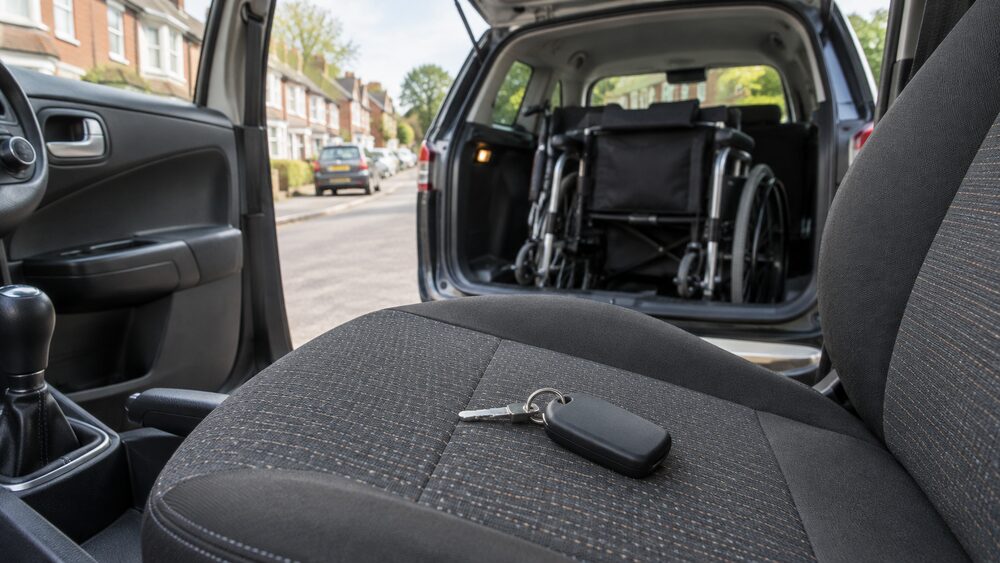
If you get the higher rate mobility part of Disability Living Allowance, the enhanced rate mobility part of Personal Independence Payment or Adult Disability Payment, or one of the other qualifying mobility benefits, you have a choice. You can hand that money to the Motability Scheme and lease a new car, wheelchair-accessible vehicle, scooter or powered wheelchair, or you can keep the cash and make your own transport arrangements.
The Scheme is not a benefit in itself. It is a lease: you exchange all or most of the higher rate mobility part of your weekly disability allowance for the course of a three year lease1. The lease payment goes straight from government to Motability each month, and some more expensive cars also need a one-off Advance Payment2. Standard scooters and powered wheelchairs cost less than the weekly allowance, while some cars cost less, some the same, and some need that extra payment1.
For 2026/27 the higher rate mobility component of DLA is £80.00 a week and the lower rate is £30.303. In Scotland, Adult Disability Payment mobility awards accounted for 31% of payments by value, £2.5 billion, in the year to 31 July 20264. Whether the Scheme is worth it depends on what you would otherwise spend on a car, insurance, tax, servicing and repairs, and on how secure your award is.
How the Motability Scheme works
The Scheme helps disabled people hire a car, powered wheelchair or scooter, and customers might qualify for a driving lessons grant8. It offers an affordable way to lease a new car, wheelchair-accessible vehicle, scooter or powered wheelchair9. The Motability Foundation oversees the delivery of the Scheme by Motability Operations, a separate company that runs it9.
Eligibility turns on the benefit you receive, not on your condition in the abstract. The qualifying awards are PIP enhanced rate mobility, DLA higher rate mobility, Scottish Adult DLA higher rate mobility, Adult Disability Payment enhanced rate mobility, Child Disability Payment higher rate mobility, War Pensioners' Mobility Supplement and Armed Forces Independence Payment5. You must have at least 12 months remaining on your award6. If the Department for Work and Pensions decides you are not eligible for the enhanced rate mobility component of PIP, you are no longer eligible to use the Scheme1.
There are limits on what you can hold at once. You cannot have more than one lease agreement, so you cannot lease a car and a powered wheelchair or scooter at the same time1. Serious driving endorsements, convictions or disqualifications in the past five years may also disqualify you10. People aged 65 and over can apply if they receive a qualifying allowance, but Attendance Allowance or Pension Age Disability Payment in Scotland cannot be used to lease a car through the Scheme1.
The Scheme began in 1978 and has since helped millions of disabled people and their families9. It has been reviewed independently: the National Audit Office published a review in December 2018, after a May 2018 report by the Commons Work and Pensions and Treasury select committees raised questions about structures, governance, government support, reserves, senior staff remuneration and the relationship with the DWP, and recommended an NAO review. The NAO concluded the Scheme provides an excellent service but raised concerns over executive reward and governance.
What a Motability lease includes and what it costs
A car lease through the Scheme includes insurance, breakdown cover, servicing and maintenance, and tyre and windscreen replacement1. Insurance covers up to three named drivers1. Under the Scheme your vehicle tax is paid each year5. If your child has the higher rate mobility component of DLA, you can lease a car using the mobility component with no payment for insurance, tax, breakdown cover, servicing or MOTs11.
The cost is the allowance itself. You exchange all or most of the higher rate mobility part of your weekly disability allowance for the course of a three year lease1. Standard scooters and powered wheelchairs cost less than the weekly allowance; some cars cost less, some the same, and some require an Advance Payment1. The Scheme announced its latest prices in March 20259.
Adaptations are a separate question. The Scheme offers around 500 different vehicle adaptations to tailor a new car to specific needs10. But the cost of adaptations, plus fitting and removal, may not be included in your lease, and you may have to pay for these yourself5. The Motability Foundation's Cars and Vehicle Adaptations grant can fund new adaptations during your lease if your needs change, and can help if the car or adaptations you need cost more than you can afford12. All applications are means tested to make sure the grant goes to people most in need of financial help12.
If your car remains suitable at the end of your lease, the Foundation may recommend you keep it for another two years12. The Scheme can also arrange a lease extension if the vehicle remains in good condition and the mileage is not excessive, with insurance, roadside recovery, service, maintenance and repairs included1.
Extra taxes on Scheme leases: what changes for you
Extra taxes will be added to cars leased through the Motability Scheme, along with restrictions on certain car brands14. From 1 July 2026, Insurance Premium Tax will be applied at the standard rate of 12% to insurance contracts relating to vehicles on the Scheme, for new leases7. The same date brings the standard rate of VAT on top-up payments on leases of motor vehicles through qualifying schemes for the use of disabled people7.
The practical effect is that the amount of allowance a lease absorbs can rise, and the range of vehicles available on terms that fit the allowance can narrow. Because the changes are tied to new leases, the timing of an order matters. The Scheme's own published prices are the place to check what a particular vehicle costs under the new rules.
Mileage limits and additional mileage support for high travel needs
Mileage up to a certain limit is included in the price of a Scheme lease15. Beyond that, the terms of the agreement apply. In July 2026 the Scheme introduced additional support for customers with the highest travel needs, for orders placed after 1 July 2026.
If you drive for work, note that the tax treatment of business mileage is separate from the Scheme. The mileage allowance only covers journeys which are wholly, or partly, for business, where this can be proven through a record of business mileage16. That is a tax rule, not a Scheme rule, and it does not change what your lease includes.
Leasing through Motability or keeping your allowance: how each one works
The two routes are genuinely different products, and the right comparison is between a leased vehicle with its running costs covered and a cash sum you control.
| Motability lease | Keeping the allowance | |
|---|---|---|
| What you get | A new car, wheelchair-accessible vehicle, scooter or powered wheelchair9 | The mobility component paid to you |
| How it is paid for | Some or all of the benefit paid directly from government to Motability each month, plus an Advance Payment on some cars2 | You decide how to spend it |
| What is included | Insurance for up to three named drivers, breakdown cover, servicing and maintenance, tyre and windscreen replacement, vehicle tax1 | You arrange and pay for insurance, tax, servicing, repairs and breakdown cover yourself |
| Adaptations | Around 500 adaptations available; fitting and removal may not be included in the lease10 | You arrange and pay for adaptations |
| If your award stops | You may have to return the vehicle17 | Payments stop, but there is no vehicle to return |
| Length | Three year lease, with possible extension1 | Runs with your award |
The lease route suits someone who wants predictable costs and does not want to arrange insurance, servicing and repairs separately. Keeping the allowance suits someone whose transport needs are met another way, who needs the cash for other costs, or who wants to keep control of a vehicle they own. The Scheme's own terms are the authority on what a particular lease includes.
What happens if you lose your award at reassessment
If you do not qualify for the enhanced rate mobility component of PIP when your award is reviewed or renewed, you may have to return your Motability vehicle17. The same applies in Scotland: if you do not qualify for the Adult Disability Payment enhanced rate mobility component, for example when your award is reviewed or renewed or you transfer from PIP, you may have to return your vehicle18.
There is support for people in this position, and it is worth knowing the names.
- Transitional Support grant: for customers who leave the Scheme following an unsuccessful DLA to PIP reassessment, where they lose their qualifying benefits and meet the grant criteria13. You do not need to apply, because Motability Operations will contact you if they are notified you have not been awarded PIP19.
- Additional Transitional Support: for a Scheme customer who cannot continue with their lease because of a DWP reassessment and cannot meet the costs of a replacement vehicle or the adaptations they need20. If you have adaptations, Motability Operations will help with the costs of fitting similar adaptations to a non-Scheme vehicle19. The Foundation may offer increased support for the additional cost of buying a large vehicle, and may provide a grant enabling purchase of a leased highly adapted vehicle20.
- Compensation payment: if you were previously on Motability but lost it when you were moved from DLA to PIP or Adult Disability Payment, you may be entitled to a compensation payment5.
The amounts paid under transitional support depend on when you joined the Scheme. For leavers who joined before 2013, the choice is £2,000 for keeping the vehicle eight weeks, or £500 for keeping it 26 weeks18. For those who joined during 2013, it is £1,000 for eight weeks, or £250 for 26 weeks18.
Reassessment is not always imminent. If your child has a condition that is not expected to improve, there will not be a reassessment for at least 5 years21. Pension Age Disability Payment can be given as an indefinite award if your needs are highly unlikely to change, meaning it will not be reviewed unless you tell them something has changed22. Adult Disability Payment under the Special Rules for Terminal Illness is automatically the highest award for daily living and the highest rate for mobility, ongoing without review unless circumstances change, regardless of how long the person has been ill23.
If a decision goes against you, the decision can be looked at again through a mandatory reconsideration, and you will be sent a letter explaining whether the original decision has been changed24. There is more on this in challenging a decision and what happens to payments during mandatory reconsideration.
Grants for wheelchair-accessible vehicles: Bespoke Passenger Solutions
The Bespoke Passenger Solutions grant is for disabled people who need additional adaptations or facilities in order to travel in their vehicle13. It may help to pay for the extra costs of a vehicle specially adapted for your needs as a passenger6. These are large wheelchair-accessible vehicles including personal care facilities, such as personal hoisting, a changing surface, privacy and storage6. The wheelchair is secured with a four-point manual tie-down system in the floor and a personal seat belt for the person seated in their wheelchair6.
The grant covers the Advance Payment for a suitable Bespoke Passenger Solution, including the cost of the vehicle and the adaptations6. To qualify you must be a disabled person, or the appointee for a disabled person, on the Motability Scheme or applying to join, and you must not be planning to change your wheelchair in the next 12 months6. An Up-Front Passenger position for the wheelchair passenger is excluded6. One of the Foundation's Mobility and Driving Advisors will visit you in person, and the Foundation assesses your needs with its own advisors rather than requiring a Driving Mobility assessment first6.
The programme was first launched in April 2022. In June 2024 the Foundation approved £10 million to continue a shorter version for two years, and in September 2026 it announced the scheme will continue until 2029 following an evaluation of its impact on disabled people, their families and carers. The Foundation states the programme is currently funded until March 20296. New Bespoke Passenger Solutions and all new accessible vehicles are leased over five years, and Nearly New ones over three years6. You can only have one grant at a time, but the Foundation will help you apply for the right one6.
Related grants include the Wheelchair Accessible Vehicle grant, which can only fund WAVs available through the Scheme, built to strict safety standards and approved by the Scheme25, and the Independent Driving Solutions grant, for independent drivers who need to transfer inside the vehicle, drive while staying in their wheelchair, or need hi-tech controls in a standard car13. The Foundation lists 8 grants in total13.
Where to get independent help
The Scheme's own pages are the authority on its terms, prices and grant criteria, but they are not independent. For free, impartial advice on benefits and money, MoneyHelper is the government-backed service. Independent Age runs a free helpline26. Charities that publish guidance on the Scheme and on disability benefits include Scope, Disability Rights UK, Turn2us and Contact5.
If a decision about your benefit goes against you, the route is a mandatory reconsideration and then, if needed, a tribunal appeal. There is guidance on appealing to a tribunal and on complaining to the DWP and the Ombudsman. If you are struggling with debt, StepChange notes that your Motability agreement can continue throughout your bankruptcy27.
For help with the wider costs of disability, see benefits and funding for the extra costs of being disabled and checking what you are entitled to. If you are moving between nations, disability and carer payments when moving between Scotland and the rest of the UK explains how awards transfer.
Sources27 cited
- Motability Scheme FAQ Motability Foundation
- Benefits FAQs Full Fact, 24 August 2026
- How much DLA will I get Turn2us
- Adult Disability Payment statistics to 31 July 2026 Social Security Scotland, 31 July 2026
- Motability Scheme Disability Rights UK, 14 April 2026
- Bespoke Passenger Solutions Motability Foundation
- Budget 2025 overview of tax legislation and rates GOV.UK
- Tips on completing the DLA form Contact, 16 June 2026
- Motability Scheme Motability Foundation
- Motability car scheme explained Which?, 3 July 2026
- Disability Living Allowance for children Entitledto
- Cars and Vehicle Adaptations Motability Foundation
- Individual grants Motability Foundation
- Benefit changes timetable 2026 Turn2us
- Armed Forces Compensation Scheme and Motability Turn2us, 9 September 2025
- Using your private car for work TaxAid, 18 May 2023
- Enhanced rate mobility of ADP: what else can I get Turn2us, 29 July 2026
- Adult Disability Payment Contact
- Transitional Support Motability Foundation
- Additional Transitional Support Motability Foundation
- Financial help for children with a disability or long-term illness One Parent Families Scotland, 6 April 2026
- Pension Age Disability Payment reviews mygov.scot, 26 September 2026
- Assistance under Special Rules for Terminal Illness mygov.scot, 24 March 2025
- Sure Start Maternity Grant nidirect, 25 June 2026
- Independent Driving Solutions Motability Foundation
- Benefits and financial help if you're a disabled adult Sense
- Bankruptcy and my car StepChange, 25 September 2026






 Turn2usFree benefits calculator and grants search from a charity
 Citizens AdviceFree advice on money, consumer and legal problems in England and Wales
 GOV.UKOfficial information on tax, benefits and government services
 MoneyHelperFree, impartial money and pensions guidance, set up by government