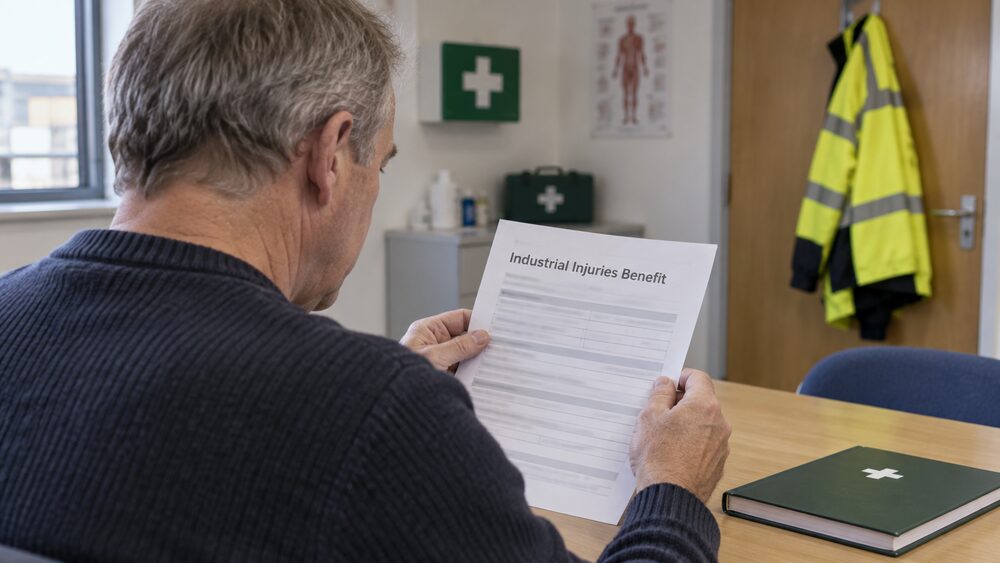
Industrial Injuries Disablement Benefit (IIDB) is a payment for people who are disabled because of an accident at work, or because of one of more than 70 diseases known to be a risk of certain jobs1. It is a no-fault scheme: you do not have to prove your employer was negligent, and the payment is made by the Department for Work and Pensions (DWP) rather than through the courts2. It is the main benefit in the wider Industrial Injuries Scheme3.
IIDB is not means tested and it is not based on your National Insurance record, so your savings and income do not affect whether you can get it4. The amount you receive depends on one thing: how disabled you are, expressed as a percentage. At 100 per cent disablement the rate is £233.90 a week from April 20265. Most claims need an assessment of at least 14 per cent, though some diseases, including asbestos-related ones, are treated differently6.
A no-fault payment for injuries and diseases caused by work
The Industrial Injuries Scheme provides non-contributory, no-fault benefits for disablement caused by an accident at work, or by one of over 70 prescribed diseases that are known to be a risk from certain jobs1. Industrial Injuries Disablement Benefit is the main benefit within that scheme3. Because it is a no-fault scheme, you do not need to show that anyone was to blame for what happened to you, and you do not need a solicitor or a court case to receive it. The DWP administers it through its Industrial Injuries Benefits Centres4.
The scheme exists because injuries at work were historically dealt with through employers' liability claims, which could be slow and uncertain. IIDB sits alongside that system: it pays a regular weekly amount based purely on the severity of your disablement. Official statistics show the scheme still reaches a substantial number of people: as at the latest count, 160,000 people claimed IIDB alone, 27,000 claimed Reduced Earnings Allowance and Retirement Allowance only, and 29,000 claimed IIDB alongside those allowances1.
Two features shape how the benefit behaves in practice. First, it is not means tested and not National Insurance based, so it does not matter how much you earn, save or receive from other sources when the DWP decides whether you qualify4. Second, the rate payable depends on the level of your disability, assessed as a percentage, so two people with the same disease can receive very different amounts6. The benefit can be paid for a fixed period or for life, depending on how permanent the disablement is7.
Who can claim and who cannot
The basic conditions are about employment and place. You must have been employed, working under a contract of employment, when the accident or the event that caused your disease happened, and the accident or event must have happened in the UK, though there are some exceptions5. There are no age rules: what matters is that you were an employee at the time, not how old you are now4. For most prescribed diseases you do not have to have worked in the occupation for any minimum length of time9.
When you claim, you have to provide your National Insurance number and evidence of your identity9. There is generally no time limit for claiming: you can still claim if your accident happened or your disease started many years ago9. This matters especially for asbestos-related conditions, which can appear decades after the exposure that caused them.
There are also routes into the benefit for people claiming on behalf of someone who has died. If your husband, wife or civil partner was disabled as a result of an industrial accident or disease that occurred before their death, and was not getting IIDB, you may be able to claim it for a period before their death10. And if your condition changes later in life, benefits like Statutory Sick Pay or IIDB may become newly claimable11.
Self-employed workers are outside the scheme
The scheme does not cover self-employed people. Self-employed workers are not covered, and you cannot usually get IIDB if you were self-employed when the accident happened or when you were exposed to the substance or conditions that caused your disease6. The same rule appears in the guidance for individual prescribed diseases: for example, you cannot claim IIDB for Dupuytren's contracture if you were self-employed12.
There are rare exceptions. There may be some cases where you can claim, for example if you were an agency worker8. Agency workers can fall either side of the line depending on their working arrangements, so the position is worth checking with an adviser rather than assuming the answer.
For people whose asbestos exposure happened during self-employment, the position is particularly harsh: you cannot usually claim IIDB if you were self-employed when you were exposed13. However, other help may exist outside the industrial injuries scheme. If mesothelioma was not caused through employment, for example because someone washed the clothing of a person who worked with asbestos, or because they were self-employed, a payment under the diffuse mesothelioma arrangements may still be possible8.
Prescribed diseases, including asbestos-related illness
The scheme covers over 70 different diseases6. These are known as prescribed diseases: illnesses officially accepted as a particular risk of a job or type of work, from lung conditions caused by dust to conditions caused by repetitive physical work3. Because each disease is tied to particular occupations, a claim usually turns on whether your work history matches the job listed for that disease. As noted above, for most prescribed diseases you do not have to have worked in the occupation for any minimum length of time9.
Asbestos-related illness is the most prominent group within the scheme. The benefit covers people exposed to asbestos dust while working for an employer, including people who are now retired or who worked in other countries for a UK company13. This reflects the long delay between exposure and illness: many people only develop asbestos-related disease decades after they left the job that exposed them.
Mesothelioma, a cancer strongly associated with asbestos, is treated specially in two ways. People with mesothelioma are entitled to the maximum IIDB rate13. And under the prescribed diseases rules, a claim for pneumoconiosis, byssinosis or diffuse mesothelioma assessed at 1 per cent or more but less than 20 per cent is paid at the 20 per cent rate14. These conditions therefore bypass the usual threshold rules that apply to most claims.
How disablement is assessed on a 1 to 100% scale
The level of your disability is assessed by a medical adviser on a scale of 1 to 100 per cent6. A doctor assesses how your disability affects you, and the extent of your disablement is stated as a percentage15. The percentage is a measure of the disablement caused by the work accident or disease, not of your overall health: conditions unrelated to work are not part of the assessment.
After sending in your claim form, you might be asked to attend a face-to-face assessment6. The assessment that results lasts either for a fixed period or for life, depending on the extent of your disability15. A fixed-period assessment is common where the condition may change, and it is followed by reassessment when the period ends.
The percentage then drives the payment directly. The weekly rates are set out in law for each level of disablement from 20 per cent to 100 per cent, and the rate of benefit payable depends on the level of your disability6.
The 14% threshold and its exceptions
To get benefit, you must usually be assessed as having at least 14 per cent disablement, although there are exceptions9. Disablement assessed between 14 and 19 per cent is rounded up to 20 per cent for payment purposes, so the first payment band is the 20 per cent rate7. Below 14 per cent, there is usually no payment at all.
The exceptions matter. Certain diseases, such as pneumoconiosis, byssinosis or mesothelioma, may attract payment even if they are assessed at less than 14 per cent6. As set out above, the legislation provides that these diseases assessed at 1 per cent or more but less than 20 per cent are paid at the 20 per cent rate14. Occupational deafness works in the opposite direction: those cases are paid at 20 per cent or more, meaning the assessment must reach the 20 per cent level6.
The timing of the assessment also follows a rule. After 15 weeks from the date of the accident, or the onset of the disease, the person claiming must be suffering from the disablement at the qualifying level for benefit to be paid6. This prevents claims being decided on a very short-term condition that has not yet stabilised.
Weekly rates from April 2026: up to £233.90
From 8 April 2026, the disablement pension is £233.90 a week at 100 per cent disablement16. The full ladder of weekly rates by degree of disablement is:
| Degree of disablement | Weekly rate from April 2026 |
|---|---|
| 100% | £233.90 |
| 90% | £210.51 |
| 80% | £187.12 |
| 70% | £163.73 |
| 60% | £140.34 |
| 50% | £116.95 |
| 40% | £93.56 |
| 30% | £70.17 |
| 20% | £46.78 |
These figures come from the up-rating legislation for 202616. For comparison, the 2025/26 standard rate at 100 per cent disablement was £225.30 a week19. Where a claimant has successive accidents, the maximum aggregate of weekly benefit payable is £233.9016.
On top of the basic pension, increases exist for particular circumstances. The increase for exceptionally severe disablement is £93.60 a week, and constant attendance allowance can add up to £187.20 a week in any case, or £93.60 except in cases of exceptionally severe disablement16. An unemployability supplement of £144.65 a week exists under the legislation, along with increases of £86.45 and £11.35 a week, and an allowance of £11.35 a week in respect of each child or qualifying young person16. The maximum disablement gratuity is £15,52016. Whether any of these apply depends on your circumstances, and the DWP guidance on financial help for disabled people sets out what else may be available alongside IIDB, including constant attendance allowance for people who need daily care and attention20.
How IIDB affects other benefits
IIDB is not taxable4. It is also not means tested, but the money you receive counts in full as income when entitlement to means-tested benefits is calculated6. IIDB, Reduced Earnings Allowance and Retirement Allowance are all taken into account in full for the calculation of all means-tested benefits21. So while winning an IIDB claim never reduces the IIDB itself, it can reduce means-tested top-ups such as Universal Credit.
The benefit can also work in your favour elsewhere. Receiving Industrial Injuries Disablement Benefit is one of the circumstances in which the Benefit Cap does not apply22. IIDB can be received alongside other disability benefits, and people claiming it may also be entitled to Reduced Earnings Allowance, which compensates for loss of earnings caused by the accident or disease23. The Barnsley IIDB centre is the contact point for details on how Reduced Earnings Allowance affects other benefits23.
For people who are terminally ill, the rules on other disability benefits include special provisions, and disability benefits are backdated to when you applied, but not before24. IIDB itself follows its own backdating rules, covered below.
How to claim in England, Scotland, Wales and Northern Ireland
IIDB applies across England, Wales, Scotland and Northern Ireland4. In England, Scotland and Wales, you claim by completing a form: you can download the application form from GOV.UK, or contact the Barnsley Industrial Injuries Disablement Benefit Centre and ask them to send you one, by calling 0800 121 8379 or using textphone 0800 169 03148. In Northern Ireland, you can download an application form at NI Direct, or ask your local Social Security or Jobs and Benefits office for a form8.
When you claim, you have to provide your National Insurance number and evidence of your identity9. After the form goes in, you might be asked to attend a face-to-face assessment, and the decision will state your disablement as a percentage6. Payment can then be made into your bank account every week, every 4 weeks or every 13 weeks13.
Scotland has its own layer of administration. In April 2020, responsibility for the remaining disability and industrial injuries benefits, including IIDB, transferred to the Scottish Government, with the DWP continuing delivery under interim agency agreements25. Scottish Ministers now make provision for the up-rating of Industrial Injuries Benefits and Severe Disablement Allowance in Scotland26. For a claimant, the practical process is unchanged: the claim, the assessment and the rates work the same way, and the pages on Adult Disability Payment and on moving between Scotland and the rest of the UK explain where the Scottish system does differ.
The DWP also publishes easy-read guides about IIDB, covering what the benefit is, who can claim it, how it affects other benefits, how to apply and what happens after you apply27. If a decision goes against you, the routes for challenging a decision and appealing to a tribunal apply to IIDB as to other DWP benefits.
Backdating, reassessment and changes in your health
A claim can be backdated for up to three months if you would have been entitled to it earlier, and it does not matter why the claim is late: you request this when you claim9. Independent guidance on backdating confirms IIDB can be backdated, and that claims can also be made in advance28. There is a further provision for people whose qualifying benefit was terminated or reduced: their benefit can be backdated to the date of the termination of the original award, or the date the qualifying benefit was awarded or re-awarded, so long as they reclaim within 3 months of the qualifying benefit being reinstated28.
Separately from backdating, there is generally no time limit for claiming IIDB at all: you can still claim if your accident happened or your disease started many years ago9. This is one of the scheme's most distinctive features and is especially important for late-onset industrial diseases.
Reassessment is built into the system. You can be reassessed if the level of disability caused by your accident or disease worsens, or when a fixed-period assessment comes to an end15. So a condition that gets worse after an earlier decision is not the end of the story: a fresh assessment can raise the percentage and with it the weekly payment. A worsening condition can also open the door to benefits that were not previously claimable, such as Statutory Sick Pay or IIDB itself11.
Payments abroad, fraud rules and where to get help
IIDB can be paid abroad, but you must inform the office that deals with your claim before you leave the UK2. The benefit is paid to employees who are liable to pay Income Tax under PAYE on wages, salaries or fees, and it is not payable where the accident or disease was contracted during self-employment2. The rules on going abroad, including holidays and permanent moves, are covered in more detail on the going abroad page.
As with all benefits, IIDB comes with obligations on your side. In Northern Ireland, the Industrial Injuries Disablement Pension appears on the list of sanctionable benefits in the benefit fraud rules, alongside related payments such as Industrial Death Benefit, Reduced Earnings Allowance, Retirement Allowance and the unemployability supplement29. This means the usual rules about reporting changes of circumstances and avoiding fraud allegations apply: the reporting changes page explains what has to be told and when.
If money is tight while you wait for a claim or a reassessment, free help exists. Debt charities such as StepChange provide guidance for people whose financial situation is affected by ill health11. Advice NI provides information on disability benefits in Northern Ireland3. For a wider check of what you might be entitled to, the page on checking entitlement lists the free calculators and advisers available, and the benefits section covers the rest of the UK benefit system.
Sources29 cited
- Annual DWP Benefits Statistics Compendium 2026 Department for Work and Pensions, 2026
- Guidance on Social Security Abroad NI38 HM Revenue and Customs, 2026
- Disability benefits Advice NI, 2026
- What is Industrial Injuries Disablement Benefit Turn2us, 2025
- Claiming benefits in Europe and EEA countries NI Direct, 2026
- Industrial Injuries Disablement Benefit Entitledto, 2026
- How much Industrial Injuries Disablement Benefit (IIDB) will I get Turn2us, 2025
- Industrial Injuries Disablement Benefit Macmillan Cancer Support, 2025
- How do I claim Industrial Injuries Disablement Benefit (IIDB) Turn2us, 2025
- Financial help for bereaved NI Direct, 2026
- Your financial situation and your health StepChange Debt Charity, 2026
- Claim Industrial Injuries Disablement Benefit for Dupuytren's contracture GOV.UK, 2019
- Mesothelioma compensation Macmillan Cancer Support, 2026
- Social Security (Prescribed Diseases) Regulations 1985 as amended legislation.gov.uk, 1986
- Can I get Industrial Injuries Disablement Benefit Turn2us, 2025
- Social Security Up-rating Order 2026 rates legislation.gov.uk, 2026
- Social Security Benefits Up-rating Order 2026 legislation.gov.uk, 2026-03-02
- Benefit and pension rates 2026 to 2027 Department for Work and Pensions, 2026
- Benefit and pension rates 2025 to 2026 Department for Work and Pensions, 2025
- Financial help if you're disabled GOV.UK, 2026
- Related benefits Turn2us, 2025
- Advice NI response on the Universal Credit Bill Northern Ireland Assembly, 2026
- Reduced Earnings Allowance GOV.UK, 2026
- Terminally ill benefits Scope, 2025
- Benefit combinations official statistics to March 2026 Department for Work and Pensions, 2026
- Industrial Injuries Benefits and Severe Disablement Allowance up-rating in Scotland legislation.gov.uk, 2026
- Easy read about Industrial Injuries Disablement Benefit GOV.UK, 2022
- An overview of the rules for backdating benefits and applying in advance Law Centre NI, 2025
- Benefit fraud NI Direct, 2026





 Turn2usFree benefits calculator and grants search from a charity
 Citizens AdviceFree advice on money, consumer and legal problems in England and Wales
 GOV.UKOfficial information on tax, benefits and government services
 MoneyHelperFree, impartial money and pensions guidance, set up by government