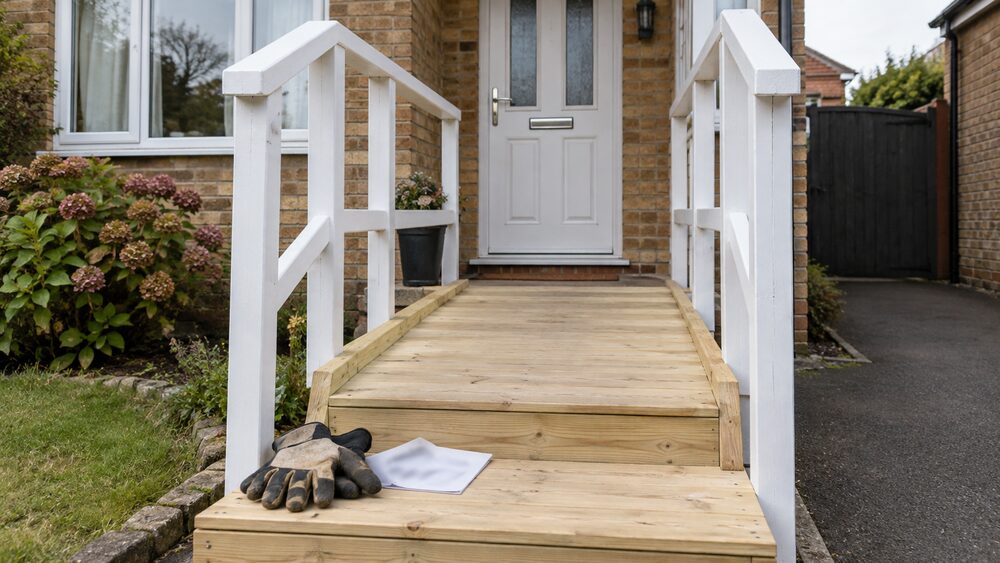
A Disabled Facilities Grant is money from your local council to adapt your home so a disabled person can live there more independently. It can pay for ramps, wider doorways, a downstairs bedroom, or an accessible bathroom or kitchen. The maximum grant is £30,000 in England, £36,000 in Wales and £25,000 in Northern Ireland1.
A Disabled Facilities Grant is money from your local council to adapt your home so a disabled person can live there more independently. It can pay for ramps, wider doorways, a downstairs bedroom, or an accessible bathroom or kitchen. The maximum grant is £30,000 in England, £36,000 in Wales and £25,000 in Northern Ireland1.
It is a grant, not a loan, so you do not usually need to pay any of the money back2. The council pays the builders directly rather than paying you2. You do not have to be claiming other benefits to be eligible, and the grant will not affect the benefits you already get2.
The rules differ across the UK. There is no Disabled Facilities Grant in Scotland, where a similar scheme operates under a different name and the mandatory grant is 80%4. The sections below cover what the grant pays for, who can apply, how the means test works, how to apply, and what can go wrong.
What a Disabled Facilities Grant pays for, and what it does not
The grant funds adaptations to the home you already live in. Typical work includes widening doors, providing ramps, or installing suitable bathroom or kitchen facilities6. It can also cover improving access to your garden or building a downstairs bedroom3.
What it will not usually cover is an extension. Financial help is not usually available for building an extension to your home4. The distinction matters: converting or adapting space inside the existing property is generally within scope, while adding new floor area is generally not.
Two other points about how the money works. The council pays the money directly to the builders who do the work and will not pay any money to you2. And you do not need to pay VAT for some adaptations that make your home more accessible, such as wider ramps, doorways or corridors and accessible showers, bathrooms or toilets2.
If the work you need falls outside the grant, other routes exist. Some organisations provide grants for items not covered by your local council or the government, and you do not have to pay them back7. For energy-related work, homeowners, private renters and social housing tenants may qualify for heating and insulation grants depending on household circumstances and property details8.
Maximum grant: £30,000 in England, £36,000 in Wales, £25,000 in Northern Ireland
The headline limit depends on where you live. The maximum grant payable is £30,000 in England, £25,000 in Northern Ireland and £36,000 in Wales1. The same figures appear across the guidance: £30,000 in England, £36,000 in Wales and £25,000 in Northern Ireland4.
| Nation | Maximum grant |
|---|---|
| England | £30,0001 |
| Wales | £36,0001 |
| Northern Ireland | £25,0001 |
| Scotland | No Disabled Facilities Grant; mandatory grant is 80%5 |
The maximum is not always the final word. The local authority has discretion to increase the maximum amount if it is not sufficient to cover the planned works4. Some councils also hold discretionary funding that can top up the amount if your adaptations cost more than the grant limit2. That is a decision for your council, not an automatic entitlement, so it is worth asking the housing department directly whether extra funding exists and how to apply for it.
The grant is means-tested, and there is usually an upper limit on the amount you can get9. The amount given depends on the savings and income of the disabled person4.
Who can apply: owners, tenants, landlords and parents
You can apply if you are an owner-occupier or a tenant6. Landlords can also apply on behalf of their disabled tenants4.
For tenants, there is a condition. Tenants must be the one responsible for doing the work; if the landlord is responsible, the tenant cannot get a grant but the landlord may apply5. So the first question for any renter is who carries the repairing and improvement responsibility under the tenancy.
Carers have a route too. The person you look after may apply if they have a disability, and you can also apply if you care for a disabled person who is living with you in your own home. In either case, it does not matter whether you are an owner-occupier or a tenant4.
If you rent from a council or housing association, your housing provider should apply for the grant for you. If you own your home or rent from a private landlord, you will probably need to do it yourself2. Social landlords will sometimes pay for adaptations themselves, but you can still apply for a Disabled Facilities Grant and should be treated the same as other applicants9.
The means test and who is exempt from it
The grant is means-tested, so the amount depends on the savings and income of the disabled person4. There is usually an upper limit on the amount you can get9.
Some applicants skip the test entirely. If the disabled person is under 19 there is no means testing at all4. The same rule is expressed as no means test if an application is made for the benefit of a child or a young person under the age of 19 for whom child benefit is payable1.
There is also a benefits route. If the person you care for is in receipt of certain social security benefits, they will be entitled to a full grant4. More broadly, if you receive another means-tested benefit, you will probably not be asked to pay for any of the costs2.
Wales has its own variation. A means test may not be applied to a small or medium disabled facilities grant in Wales, depending on your local authority1.
It helps to separate this from disability benefit rules, which work differently. The main disability benefits are not means-tested, so any income, including student grants or loans, and savings are ignored for those10. The Disabled Facilities Grant means test is a separate calculation about the grant itself.
How to apply: assessment, decision within six months and payment
The process starts with your council's housing department, which administers and pays Disabled Facilities Grants and can only be used for the purposes set out in the rules9. An occupational therapist or similar assessor usually visits to establish what the disabled person needs.
There is a legal deadline on the council. By law, the council must give you a decision within 6 months2. The housing department must give their decision in writing within six months of the date of application for the grant4. There is a 6-month time limit for the local authority to give you a decision1.
Once approved, the clock changes. A Disabled Facilities Grant will usually only be paid if the work is carried out within 12 months of the date of when the application is approved4. The council pays the money directly to the builders who do the work and will not pay any money to you2.
Scotland runs a different scheme
You cannot get a Disabled Facilities Grant in Scotland5. A similar scheme is in operation there but is not called a Disabled Facilities Grant4. In Scotland, the mandatory grant is 80%4.
Help with adaptations in Scotland runs through the housing system rather than a grant of this name. After receiving a council adaptation grant, the property must be mainly used as a private home, be the disabled person's main home and be kept in good repair7.
Scotland also runs its own discretionary support. The Scottish Welfare Fund is a discretionary, budget-limited grant scheme that prioritises applications according to need8. Separately, the DWP continues to administer Severe Disablement Allowance and Industrial Injuries Disablement Benefit in Scotland under Agency Agreements11.
If you are moving between Scotland and the rest of the UK, the disability and carer payments you receive can change, and it is worth checking how a move affects both your benefits and any adaptation grant you might apply for.
Will a Disabled Facilities Grant affect my benefits?
No. The grant will not affect your benefits3. It is a grant rather than a loan, so you do not usually need to pay any of the money back2.
That matters because a loan or a capital payment can sometimes reduce means-tested benefit entitlement. A Disabled Facilities Grant does not work that way. You also do not have to get other benefits to be eligible for a Disabled Facilities Grant in the first place2.
The means test on the grant is about how much grant you receive, not about your benefit award. If the disabled person is under 19 there is no means testing at all4, and if the person you care for is in receipt of certain social security benefits, they will be entitled to a full grant4.
If you are claiming benefits and want to check how any change in your circumstances affects your award, free calculators and advisers can help.
Do I have to stay in the property after the adaptations are done?
Yes, for a period. It is a requirement that the property is the sole or main residence for the disabled person and that they intend to live there for at least five years after the work is completed, or for a shorter period if there are health or other special reasons4.
The same condition appears in the Scottish scheme in slightly different words: after you receive the grant, the property must be mainly used as a private home, be the disabled person's main home and be kept in good repair7.
In practice this means the grant is tied to the home, not to the person. If the disabled person moves out soon after the work, or the property stops being their main home, the council can look at recovering the grant. Anyone thinking about moving within five years of the work should raise it with the housing department before applying.
Where to get free help
Several organisations give free, impartial information on Disabled Facilities Grants and home adaptations, including Scope, Age UK, Turn2us and Disability Rights UK2. Carers UK covers grants and schemes for people who look after someone4.
If a council decision goes against you, or the council does not decide within the six-month limit, you can ask for the decision to be looked at again and, if needed, take the complaint further. Free advice services can help you work out what to challenge and how.
For benefits that often sit alongside a grant application, including help with rent, Council Tax Reduction and disability benefits, the benefits section sets out who qualifies and how claims work.
Sources11 cited
- Disabled Facilities Grants Disability Rights UK, 2026-04-14
- Disabled Facilities Grant: home adaptations Scope, 2026-08-10
- Disabled single parents Gingerbread, 2026-02-10
- Grants and schemes Carers UK, 2026-09-26
- Who does it help Turn2us, 2026-04-28
- Disabled Facilities Grants in England, Wales and Northern Ireland Turn2us, 2026
- Paying for adaptations Shelter Scotland, 2023-12-15
- Scottish Welfare Fund statistics update to 31 March 2026 Scottish Government, 2026-07-28
- Disabled Facilities Grants to adapt your home Age UK, 2026-03-24
- Scottish Welfare Fund statistics update to 31 March 2025 Scottish Government, 2025-07-29
- Annual DWP benefits statistics compendium 2026 Department for Work and Pensions, 2026-09-15








 Turn2usFree benefits calculator and grants search from a charity
 Citizens AdviceFree advice on money, consumer and legal problems in England and Wales
 GOV.UKOfficial information on tax, benefits and government services
 MoneyHelperFree, impartial money and pensions guidance, set up by government