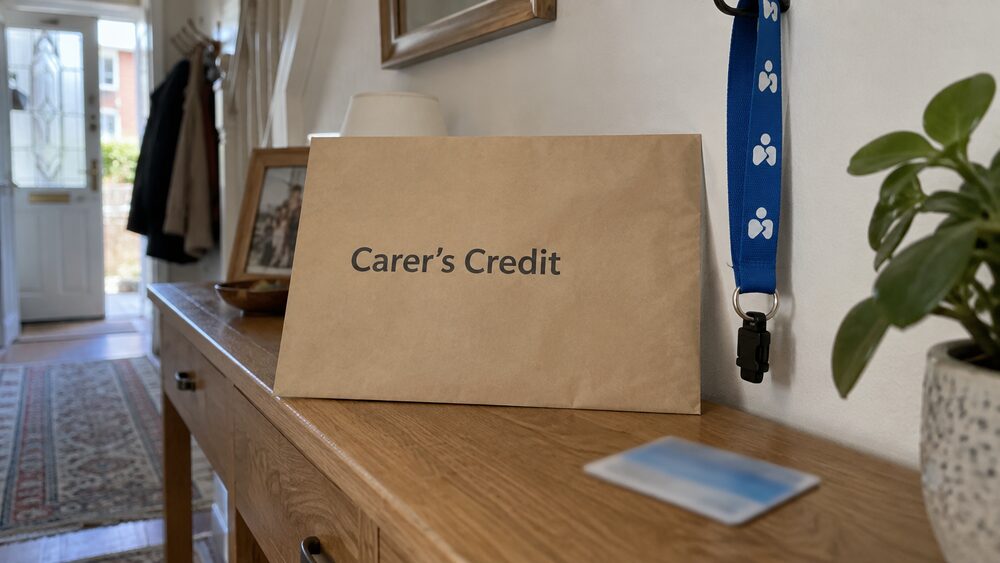
Carer's Credit is a National Insurance credit that fills gaps in your National Insurance record1. It pays no money at all: you do not get paid any extra money if you claim it2. What it does is protect the record your State Pension is worked out from, so that years spent caring do not leave a hole that reduces your pension later.
Carer's Credit is a National Insurance credit that fills gaps in your National Insurance record1. It pays no money at all: you do not get paid any extra money if you claim it2. What it does is protect the record your State Pension is worked out from, so that years spent caring do not leave a hole that reduces your pension later.
You can get it if you are under State Pension age and look after someone for more than 20 hours a week3. The hours can be spread across more than one person, so long as the total reaches 20 hours or more a week2. You do not have to be on a low income: Carer's Credit is not means-tested, so your income and savings are not taken into account4.
The credit matters most to carers who miss out on Carer's Allowance, usually because they earn too much or do not care for one person for long enough. If you already get Carer's Allowance, Carer Support Payment or Universal Credit as a carer, you are already credited and do not need to claim Carer's Credit separately5. Everyone else has to apply, and there is a deadline for claiming for past years.
Carer's Credit pays no money but fills gaps in your National Insurance record
National Insurance credits are a way of maintaining your National Insurance record when you are not making National Insurance contributions9. They help to avoid gaps in your record and protect your benefits10. Carer's Credit is one of these credits, aimed specifically at people whose working life is interrupted by caring.
The practical effect is on your State Pension. Carer's Credit helps build your entitlement to the State Pension by making sure there are no gaps in your National Insurance record4, and the credits count towards State Pension7. Carer's Credits can help you qualify for things like the State Pension11. Guidance published in Polish by Macmillan puts the same point plainly: the person receiving it does not get any money directly, but the benefit helps them keep their right to a State Pension12.
Because no money changes hands, Carer's Credit is easy to overlook. It does not appear in your bank account, and there is no payment to notice stopping. The only way to see it is on your National Insurance record, which is why checking that record matters if you have spent time caring.
It is also worth being clear about what Carer's Credit is not. It is not a top-up to Carer's Allowance, and it is not paid on top of anything. If you are already getting Carer's Allowance, you do not need to claim Carer's Credit as your pension is already protected13. The two exist side by side because they cover different groups of carers, not because one adds to the other.
Who can get Carer's Credit: 20 hours a week of care
The core test is time spent caring. You must be caring for one or more disabled people for at least 20 hours per week14. Carer's Credit is a National Insurance credit for those under State Pension age and looking after someone for more than 20 hours a week3. If you are currently under State Pension age and care for someone for at least 20 hours per week, you may be able to claim15.
The hours do not have to be spent on one person. You can care for one or more people for 20 hours or more a week and still qualify, which matters for carers who split their time between, say, a parent and a disabled adult child2. The same 20 hour threshold appears in the Scottish legislation for the Carer Additional Person Payment, where care must be at least 20 hours in an award week16.
There is a second condition beyond the hours: the person you care for must meet a qualifying test. That is usually about the benefits they receive, but there is a fallback route where they receive none.
Qualifying benefits, or a Care Certificate if there are none
Normally the person you care for must be getting a qualifying disability benefit. If they are not, you might still be able to claim by completing a Care Certificate1. This is the route for carers looking after someone who has not claimed, or cannot claim, the benefits that would otherwise open the door.
Under this route, the Department for Work and Pensions will consider whether the level of care you provide is appropriate for you to get Carer's Credit. You complete the Care Certificate section of the form and ask a health or social care professional to sign it5. The claim then rests on a signed certificate from a health or social care professional confirming that the level of care being provided is appropriate17.
So there are two routes into Carer's Credit: either the disabled person is entitled to a qualifying benefit, or you use the certification route17. Registered foster carers also count as carers for these credits7.
The Care Certificate route is the one most often missed, because it requires a conversation with a professional who may not know the form exists. It is worth knowing it is there before assuming you are shut out because the person you care for has never claimed a disability benefit.
When Carer's Credit is automatic and when you must apply
Some carers get their National Insurance record protected without doing anything. Carer's Allowance recipients automatically receive Class 1 credits on their National Insurance record9, and get National Insurance credits for each week they receive Carer's Allowance6. Those entitled to Universal Credit as a carer are automatically given Class 3 National Insurance credits5. National Insurance credits are either given automatically or applied for17. Carer's Credit itself is not automatic for everyone: those not getting Carer's Allowance or Carer Support Payment, and not in the automatic groups, must apply, with contact details on the DWP Carer's Credit page13.
Everyone else has to apply. Where you are not getting Carer's Allowance or Carer Support Payment and are not in one of the automatic groups, you must apply for Carer's Credit, and the contact details are on the DWP Carer's Credit page17. Broadly, you will either get credits automatically or you will have to apply for them18.
| Your situation | What happens to your National Insurance record |
|---|---|
| You get Carer's Allowance | Class 1 credits automatically, for each week of the award6 |
| You get Universal Credit as a carer | Class 3 credits automatically5 |
| You get Carer Support Payment in Scotland | Already credited, no need to rely on Carer's Credit rules5 |
| You care 20 hours or more but get no carer's benefit | You must apply for Carer's Credit17 |
The distinction matters because the automatic groups are defined by what you claim, not by how much you care. A carer doing 20 hours a week who has never claimed a carer's benefit sits outside the automatic groups entirely, and the only way to protect the year is a claim.
How to apply and the deadline for backdating
Carer's Credit is claimed from the Department for Work and Pensions, using the contact details on the DWP Carer's Credit page17. In Northern Ireland the route is different: you apply using the Department for Communities Carer's Credit application form19.
The deadline is the part most carers get wrong. Carers can apply for Carer's Credit up to the end of the tax year following the tax year when caring took place7. In practice that gives you a window of a little over a year after the end of the tax year in which you cared, and once it closes the year cannot be filled in this way.
For comparison, the cash carer's benefits have much shorter backdating windows. Carer's Allowance can be backdated 13 weeks if you have been eligible for that long1, and you can backdate your claim by up to three months20. Carer Support Payment in Scotland can be backdated for up to 13 weeks before your date of claim, if you met all the qualifying rules during that time21. Pension Credit applications can only be backdated by three months22, and Universal Credit cannot normally be backdated at all, though a claim can be backdated for up to one month in certain circumstances, including disability, an illness that stopped you claiming, or a DWP system outage23.
If you are claiming Carer's Credit for a past year, it helps to have the dates of caring to hand, and to know which qualifying benefit the person you care for was receiving at the time, or to have the Care Certificate signed.
Breaks in caring and changes you must report
Any changes in circumstances which might affect entitlement to Carer's Credits must be reported19. If circumstances change, for example entering paid employment or moving home, eligibility for claiming Carer's Credit may be affected, and the DWP states that changes should be reported as soon as possible13. Reportable changes include no longer caring for someone, no longer getting Carer's Allowance, a temporary break from caring, care dropping below 35 hours, sharing caring responsibilities, starting to earn a wage for being a carer, and the person cared for no longer getting Attendance Allowance, Disability Living Allowance or Personal Independence Payment, going into hospital, going into respite care or dying23.
The changes that matter for carers on Universal Credit give a good picture of what counts: no longer caring for someone, no longer getting Carer's Allowance, a temporary break from caring, care dropping below 35 hours, sharing caring responsibilities, starting to earn a wage for being a carer, the person you care for no longer getting Attendance Allowance, Disability Living Allowance or Personal Independence Payment, going into hospital, going into respite care, or dying24. The general list of reportable changes for benefits is wider still, covering work and hours, income going up or down, starting or stopping education or training, moving house, people moving in or out, bereavement, a new baby, starting or stopping caring, marriage or divorce, going abroad for any length of time, going into hospital, a care home or sheltered accommodation, changes to a medical condition, changing doctor, and changes to pensions, savings, investments or property25.
Hospital and care home stays are the ones carers most often miss. Moving into a home may affect your Carer's Credit or the Carer's Credit of someone who looks after you26. On the Universal Credit side, the carer element will also stop if your Carer's Allowance stops due to the person you look after being in hospital27, and the carer element stops after 28 days when the cared-for person is in hospital28.
Carer's Credit and the State Pension
The whole point of Carer's Credit is the State Pension. The credits count towards State Pension7, and Carer's Credit helps build your entitlement to the State Pension by making sure there are no gaps in your National Insurance record4. Carer's Credits can help you qualify for things like the State Pension11.
A qualifying year for State Pension purposes is built from contributions or credits. The Lower Earnings Limit for 2026/27 is £129 a week, £6,708 a year, and it is used for qualifying year and carer's allowance credit calculations29. That figure matters because it is the line at which earnings start to count for a qualifying year, and it is the benchmark the credit system works around.
If you are getting Carer's Allowance, the credit is Class 1 and comes automatically each week of the award6. If you are getting Universal Credit as a carer, it is Class 35. Either way the effect on the record is to fill the year.
Carer's Credit in Scotland, Wales and Northern Ireland
Carer's Credit itself is a National Insurance credit and works across the UK, but the carer's benefit sitting alongside it differs by nation, and that changes who needs to claim the credit.
In Scotland, Carer Support Payment has replaced Carer's Allowance and is now available across Scotland30. Carer Support Payment can be backdated for up to 13 weeks before your date of claim, if you met all the qualifying rules during that time21. If you get Carer Support Payment you are already credited with National Insurance contributions, so you do not need to rely on Carer's Credit rules5. If you get Carer's Allowance and move to Scotland, the practical steps change with the benefit that replaces it31.
In Northern Ireland, the application route is the Department for Communities Carer's Credit application form19, and the credits count towards State Pension7. If you need to report a change of address for Carer's Allowance in Northern Ireland, you contact the Department for Communities rather than the DWP31. For State Pension queries in Northern Ireland you can call the Northern Ireland Pension Centre32.
Wales uses the same DWP Carer's Credit system as England, with no separate carer's credit scheme.
Where Carer's Credit stops, and what else is available
Carer's Credit protects a National Insurance record. It does not put money in your pocket, and it does not replace the income that caring can cost you. If you need money rather than a record, the carer's benefits are the ones to look at, and they have their own rules, including an earnings limit and a 35 hour caring test for the Universal Credit carer element1.
Carer's Allowance is not means-tested, so your savings and your partner's income are not relevant1, but it does count as income for other means-tested benefits such as Universal Credit33. That interaction is why claiming a carer's benefit is not always a straightforward gain, and why checking entitlement across benefits together is worth doing.
There is also a limit on how often some carer arrangements can change. You can only change the responsible carer in a Universal Credit claim once in any 12 month rolling period starting from the date that the latest change happened34.
For free, impartial help, MoneyHelper explains the benefits and tax credits available to carers1, and Carers UK publishes guidance on Carer's Credit and on caring and your State Pension13. If a decision goes against you, the Carer's Allowance Unit can be contacted on 0800 731 029735, and there are formal routes for challenging a decision.
Sources35 cited
- Benefits and tax credits you can claim as a carer MoneyHelper, 2026-09-25
- Carer's Credit Carers UK Scotland, 2026-09-26
- Dementia and managing money nidirect, 2026-09-03
- Carer's Credit Which?, 2026-08-06
- Can I get Carer's Credits Turn2us, 2025-12-23
- Carer's Allowance Carers UK, 2026-09-26
- Getting credits towards your State Pension nidirect, 2026-06-25
- Carer's Allowance Which?, 2026-04-06
- National Insurance credits Which?, 2026-04-06
- Help if you're not working GOV.UK, 2026-09-28
- What are Carer's Credits Turn2us, 2025-12-23
- Claiming benefits Macmillan Cancer Support, 2025
- Carer's Credit Carers UK, 2026-09-26
- Guidance on social security abroad (NI38) GOV.UK, 2026-07-07
- Caring and your State Pension Carers UK, 2026-09-26
- The Carer Additional Person Payment (Scotland) Regulations 2025 legislation.gov.uk, 2026-03-15
- Carer's Credit Entitledto, 2026-09-26
- What are National Insurance contributions Turn2us, 2026-01-09
- How do I claim Carer's Credits Turn2us, 2025-12-23
- What carer's benefits Independent Age, 2026-09-26
- Carer Support Payment Contact, 2026-04-28
- Applying for Pension Credit nidirect, 2026-07-06
- Universal Credit Disability Rights UK, 2026-04-30
- Reporting a change in caring (Universal Credit) Entitledto, 2026-09-26
- Report a change in your circumstances GOV.UK, 2026-09-26
- Residential care and nursing homes and benefits nidirect, 2026-08-05
- Carer's Allowance and breaks in care Carers UK Scotland, 2026-09-26
- Carers Turn2us, 2025-11-06
- National Insurance credits for carers Low Incomes Tax Reform Group, 2026-04
- Carer Support Payment Carers UK Scotland, 2026-04
- I get Carer's Allowance and I'm moving to Scotland Turn2us, 2026-03-03
- Get your State Pension nidirect, 2026-08-18
- Carer's Allowance Scope, 2026-04-22
- Your dependent child's age (Universal Credit) Entitledto, 2026-09-26
- Carer's Allowance Which?, 2026-09-26












 Turn2usFree benefits calculator and grants search from a charity
 Citizens AdviceFree advice on money, consumer and legal problems in England and Wales
 GOV.UKOfficial information on tax, benefits and government services
 MoneyHelperFree, impartial money and pensions guidance, set up by government